
Get You Updated on Playground Equipment News.
You are going to sign a multi-year lease on a warehouse when you reading this article. The landlord looked reliable , while the rent seemed reasonable. Stop right there, the ceiling must be "high enough". As a 15-years experienced indoor playground equipment manufacturers field, I have seen countless ideals got lost in the scouting phase than in the operating phase.
In this industry, height is not just a design choice ,and it means more. Actually,it's a necessity dictated by gravity, physics, and insurance underwriters in your own market. You aren't just buying steel and springs but also buying a vertical experience,if you are currently hunting for trampoline park equipment for sale. If your building doesn't have the enough capacity to let that experience breathe, you will surely be failed in the future .
This article is aming to dive into the trampoline park building requirements that separates the million-dollar moguls from the bankrupt amateurs.
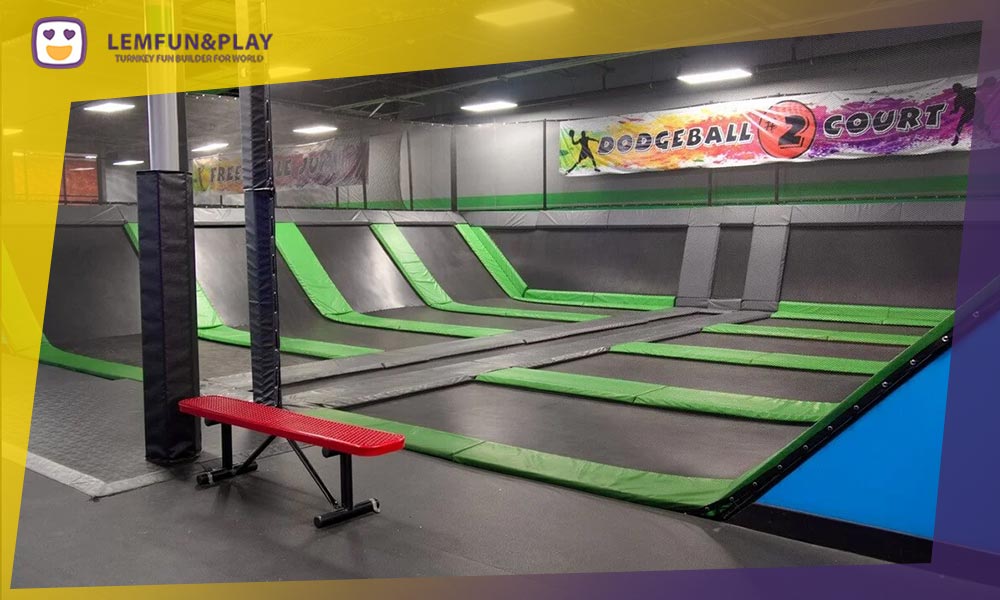
Freshmen often make a common mistake, for which they measure their own height, and think 4.5 meters is plenty enough for their business. Their thoughts will compeletely lead to a terrible result. In the engineering department at Lemfun, we view a building as a "vertical sandwich." If you don't have enough layers, the whole trampoline park can not stand at all.
The trampoline mat is not a floor but a suspension system.In order to make sure a commercial-grade trampoline, we require deserve a deflection zone.
When a 90kg adult jumps from a height of 2 meters platform, the force exerted on the mat is massive. The springs and the mat must stretch. If that mat is too close to the concrete floor, the jumper will "bottom out."
The Injury Risk: Bottoming out is the main vain of catastrophic ankle and spinal injuries. To prevent this, we Lemfun build trampoline frames between 1,000mm and 1,200mm high. This space is non-negotiable when we facing the safety factor.
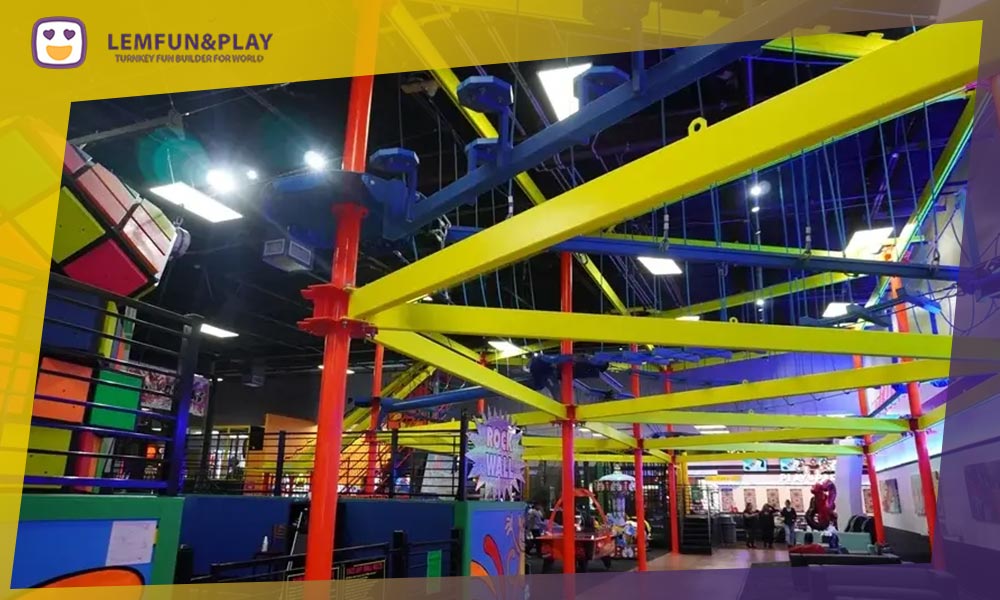
On top of that 1.2-meter base, we install the "Active Zone."
Safety Enclosures: Your enclosure nets need to be high enough so that even if a player double-bounces and loses control, they cannot fly over the top of the net.
Integrated Features: If you want basketball hoops (Slam Dunk zones), the backboard and rim assembly themselves require significant vertical clearance. A standard rim is 3.05 meters high. To mount that safely above a trampoline bed that is already 1.2 meters off the ground, your ceiling is already feeling the pressure.
This is the "Air" above the equipment. According to ASTM (American Society for Testing and Materials) and EN 1176 (European Standards), there must be a specific clear zone between the highest point a jumper can reach and the lowest ceiling obstruction.
Performance Mats: If you install "Olympic-grade" mats—which are a massive revenue driver for teens and parkour enthusiasts—jumpers can reach heights of 4.5 to 5 meters above the floor. If your ceiling is 5 meters, their head hits the steel rafters.
The Math Recap: 1.2m (Base) 3.0m (Jump Zone) 1.8m (Safety Buffer) = 6.0 Meters. Anything less, and you are cutting into your safety margin or your profit potential.
The "Hidden" Ceiling: The Infrastructure That Steals Your Height
When a landlord shows you a "6-meter building," they are usually talking about the "clear span" to the roof deck. But you are not playing against the roof deck; you are playing against the lowest hanging object.
Commercial trampoline parks generate massive amounts of body heat. You will need industrial-sized HVAC (Heating, Ventilation, and Air Conditioning) units. These ducts are massive—often 0.8 to 1 meter in diameter. If they run across the middle of your "Main Court," your 6-meter ceiling just became a 5-meter ceiling.
Fire marshals are the ultimate gatekeepers of your business. In the United States and Europe, fire codes are extremely strict about "Sprinkler Obstruction."
The Spray Pattern: If your equipment (like a Ninja Course or a multi-level Soft Play) is too close to the ceiling, it blocks the water spray.
The Fix: You either have to install "In-Rack Sprinklers" (which costs a fortune) or lower your equipment. If your building is already low, you’ll end up with a park that looks like a basement playroom rather than a professional sports arena.
High-intensity LED sports lighting and professional sound systems require mounting brackets. While small, they contribute to the "visual clutter" and physical height reduction. At Lemfun, we always ask for a 3D Laser Scan or a detailed Reflected Ceiling Plan (RCP) before we even start the 3D design of your equipment.
I want to tell you about a client in Quebec. He found a space that was $3 per square foot cheaper than the industrial park next door. Total annual savings? $24,000. It looked like a brilliant move. The only catch? The ceiling was 4.8 meters.
He ignored my warning. He bought a "budget" trampoline set from a manufacturer who didn't care about his long-term success.
The Disaster Timeline:
Month 2: The insurance inspector arrives. He sees the "High Performance" mat is only 1.5 meters away from a concrete support beam. He refuses to issue the liability policy.
Month 3: The city building inspector refuses the occupancy permit because the fire sprinklers are blocked by the Ninja Course frames.
The "Solution": To open his doors, the owner had to hire a specialized construction crew to jackhammer the floor and excavate "pits" under every trampoline.
The Bill: * Excavation and soil removal: $18,000
Concrete reinforcement and waterproofing: $12,000
Legal and re-inspection fees: $5,000
Lost Revenue (2 months delay): $40,000
The Lesson: He saved $24,000 in rent but spent $75,000 just to fix a height problem. In the B2B world, cheap is the most expensive way to go.
If you are stuck with a low-ceiling building, you might think: "I'll just dig pits for the trampolines." As an experienced indoor playground equipment manufacturer, let me give you the reality check on digging.
Once you dig into the ground, you are fighting the water table. If your waterproofing fails, your trampoline pits become indoor swimming pools. The humidity will rust your springs and rot your padding within six months.
Most warehouse floors are "Slab on Grade." When you cut into them, you risk compromising the structural footings of the entire building. You will need a structural engineer to sign off, and your landlord will likely demand a massive restoration bond (money held in escrow) to ensure you can fill the holes back in when you leave.
Based on my 15 years of data, building a "Pit-Based" park costs 150% to 200% of the cost of a "Platform-Based" park. It is a desperate measure, not a smart strategy.
High-Revenue Attractions and Their "Violent" Space Demands
If you want to maximize your Return on Investment (ROI), you need attractions that command a premium ticket price. These are almost always "Vertical Attractions."
Ziplines are the ultimate "social media" attraction. But they are governed by the law of the "Sag Rate."
The 3-6% Rule: A steel cable will sag between 3% and 6% of its length when under load. If your zipline is 30 meters long, that’s a 1.8-meter sag in the middle.
The Foot Clearance: You need 1.8 meters of "No-Go Zone" under the rider to ensure they don't kick a spectator in the head.
The Calculation: If your cable starts at 5 meters, sags to 3.2 meters, and you need 1.8 meters of clearance... you are cutting it very close. In a 6-meter hall, we can hang the cable at 5.5 meters, allowing for a thrilling, safe ride.
This game requires players to bounce off a trampoline and stick to a Velcro wall.
Competition Standard: To make this challenging for adults and teens, the wall needs to be at least 3.6 meters high.
The Headroom: A player jumping to the top of a 3.6-meter wall needs at least 1.5 meters of air space above them to avoid a head-strike during the "rebound" phase.
Total Height Needed: 1.2m (Base) 3.6m (Wall) 1.5m (Safety) = 6.3 Meters. ### 3. Ninja Warrior Courses (Multi-Level)
The trend in 2026 is "Stacked Ninja Courses." We build the easy course on the bottom and the "Extreme" course directly above it. This doubles your capacity per square meter. However, each "level" needs at least 2.5 meters of height. Add the safety padding and the floor structure, and you are looking at a 7-meter requirement for a true double-decker experience.
I recently worked with a client in Bucharest, Romania. He had a 7-meter hall but was struggling with a boring 2D layout from a local supplier. We applied our "Vertical Integration" strategy.
The Lemfun Solution:
Elevated Party Rooms: We didn't waste floor space on birthday rooms. We built them on a mezzanine 4 meters in the air.
The "Under-Play": Beneath the party rooms, we installed a high-density "Toddler Jungle" and a parent lounge.
Sky-Track: We installed a "Rollglider" track that circled the entire park at the 6-meter mark.
The Result: He increased his "Player Capacity" by 40% compared to the original design. Because he had the height, he could "stack" his revenue streams. He didn't just sell trampoline tickets; he sold "The Experience."
Floor Loading: The "Invisible" Weight Requirement
You’ve found the 6-meter height. You’re happy. But did you check the concrete thickness?
A trampoline park is a heavy industrial installation.
Static Load: The steel frame for an 800sqm park weighs tens of thousands of kilograms.
Dynamic Load: This is the force of 100 people jumping in unison. This creates a "vibrational frequency" that can crack thin concrete slabs.
Minimum: 500kg per square meter. This is for basic trampoline zones.
Advanced: 800kg to 1,000kg per square meter for multi-level Ninja structures or large slides with water-landing simulations.
Testing: If the warehouse is old, we recommend a Core Drill Test to check the PSI of the concrete. If the floor fails, the height doesn't matter—the building will literally break under your feet.
HVAC and Energy: The 6-Meter Efficiency Secret
"But won't it cost a fortune to cool a 6-meter room?" This is the most common objection I hear.
The Reality: High ceilings are actually an advantage for air quality.
CO2 Displacement: In a low-ceiling park, the CO2 and body odor from 100 sweaty kids concentrate quickly at head level. In a 6-meter hall, the volume of air is greater, leading to a fresher environment.
The Stratification Strategy: At Lemfun, we design HVAC systems that focus on "Comfort Zones." We don't try to cool the air at 6 meters. We use high-velocity, low-speed (HVLS) fans to create a "breeze effect" and focus the cooling power on the bottom 2.5 meters where the people actually are.
Thermal Buffer: The top 3 meters of air act as a thermal buffer. Hot air rises. In a tall building, the heat sits in the rafters, away from your customers. In a short building, the heat sits on their shoulders.
Insurance and Safety: Lowering Your "Risk Profile"
Insurance premiums are the "hidden tax" on trampoline parks. In the US market, premiums have skyrocketed. How do you lower them? By exceeding building requirements.
ASTM Compliance: When you have 6 meters of height, you can easily meet the 1.5-meter clearance requirement for high-bounce zones. An insurance adjuster sees this and marks your park as "Low Risk."
EN1176 Certification: Our equipment at Lemfun is manufactured to meet these rigorous European safety standards. We use thicker padding (8cm of cross-linked PE foam) and finer mesh nets that prevent "finger entrapment."
The "Headroom" Dividend: If you have 6 meters of height, the chance of a "Head-to-Ceiling" collision is zero. That single fact can lower your annual premium by 15-20%.
Q: Is 5 meters truly impossible?
No, but it is a "Dead End" for growth. My Experience: You can build a 5-meter park, but you are limited to "Soft Play" and "Junior Trampolines." You will struggle to attract the 12-25 age demographic, which is where the real money is made. You are essentially building a "Toddler Center" with a trampoline label.
Q: What if the landlord won't let me dig?
Walk away from the deal. My Experience: If you have a low ceiling and can't dig, you cannot build a professional-grade park. Do not try to "cheat" the height by lowering the platform to 0.5 meters. You will hurt people. Your reputation—and your bank account—won't survive the first lawsuit.
Q: How do I measure "Net Clear Height" accurately?
Hire a professional surveyor. My Experience: Don't trust the landlord's brochure. Use a laser distance meter to measure the height from the floor to the lowest point of the lowest fire pipe or support beam. That is your true "Usable Height."


We use cookies to enhance your browsing experience, serve personalized ads or content, and analyze our traffic. By clicking "Accept All", you consent to our use of cookies.
