
Get You Updated on Playground Equipment News.
You are desired to enter one of the most lucrative industries in the modern entertainment sector when you read this professional article. But let me state one thing directly: if you come here for buying a "turnkey" park for the price of a luxury SUV, you’ve already lost.
I’ve spent more than 10 years as a veteran at Lemfun,which performs a playground equipment manufacturer that has seen the rise and fall of hundreds of parks. My job isn't to sell you a dream, but making sure you don't build a nightmare which leads your business to failure. When you ask for the cost of building a trampoline park, you are actually asking the wrong question. The real question you really need to confirm is "How much does it cost to build a park that won't get shut down by the fire marshal or a lawsuit within its first year?"
This guide is aiming to peel back the layers of steel, foam, and certifications to show you exactly where every dollar goes.
The Price Per Square Meter Illusion Shows The Truth Cheap Quotes are dangerous
When you send an inquiry to a Chinese factory, the first number you’ll hear is likely $80 to $120 per square meter. If you hear $40 or $50, be more careful about it.
Why the Price of Trampoline Varies
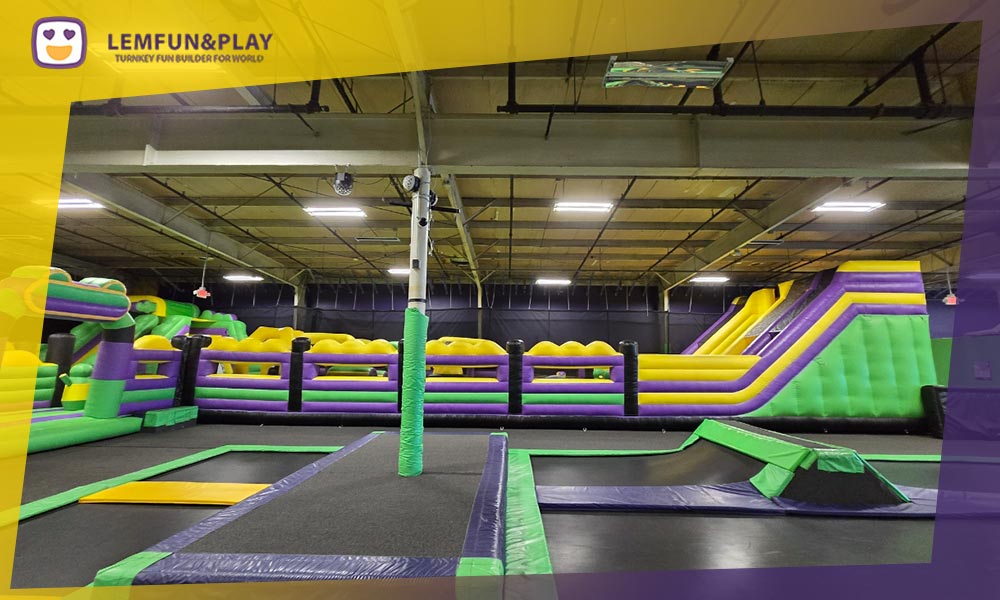
A trampoline commercial setup is not a "product" you pick off a shelf but a customized engineering project. The variance in price sometimes jumping to $150/sqm. In a short, it is driven by Equipment Density.
Imagine two 1,000sqm spaces in the same area.
Space A owns more than 80% free jump area with just mats and springs. This is cheap to manufacture but boring to visit. While space B has a ninja course, a donut slide, a high-altitude ropes course, and an Interactive wall.Though Space B costs 40% more to build, but it will have a 200% higher revenue and much better customer retention. To be honest, an empty space is wasted rent in this industry.
The truth is :You pay the same lease for the floor regardless of what equipment is on it. If you give up the density to save on the initial "per meter" price, you are effectively losing your competition.
The Manufacturer's Secret
Many manufacturers you find online are actually trading companies. What they do is taking your $100/sqm, keeping $30 as commission, and then squeezing a small, unlicensed factory to produce your equipment only for $70. When a spring snaps or a weld fails, that trading company will disappear without any responsibilities.We Lemfun own the whole set of machines, and we know the cost of the steel as we buying it by ton. That is the real difference between a "saler" and a "veteran."
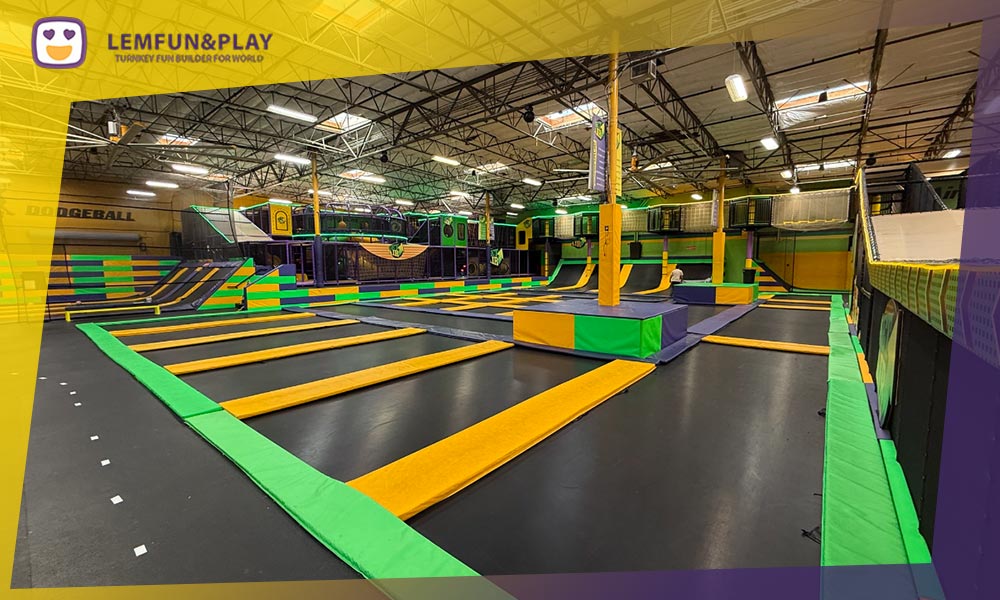
In my ten years, the most common "cost-cutting" move I’ve seen involves the foam padding. This is the material that prevents a child from breaking a bone when they miss the mat.
Low-end factories use EPE (Pearl Cotton). It’s light, it’s cheap, and it’s garbage. Under the constant pounding of 80kg teenagers, EPE loses its "rebound" within 3 to 6 months. It becomes flat, hard, and useless.
At Lemfun, we use High-Density XPE Foam.
Our Standard: 8cm thickness for buffer zones.
The Structural Sandwich: For the platforms where people walk and stand, we use 1.5cm high-strength plywood 3cm premium sponge. This 4.5cm total thickness is the gold standard.
If a supplier quotes you a price that seems "too good to be true," ask for the specific density and material of the padding. If it’s under 4.5cm total or uses EPE, you aren't saving money; you are just delaying an expensive replacement and an inevitable injury claim.
The foam is wrapped in PVC. Cheap PVC cracks under UV light or heavy friction. Once it cracks, sweat and bacteria seep into the foam. Now your park smells, and you’re looking at a $20,000 replacement bill for all your padding within 12 months. Invest in 0.55mm thick, fire-retardant PVC from the start.
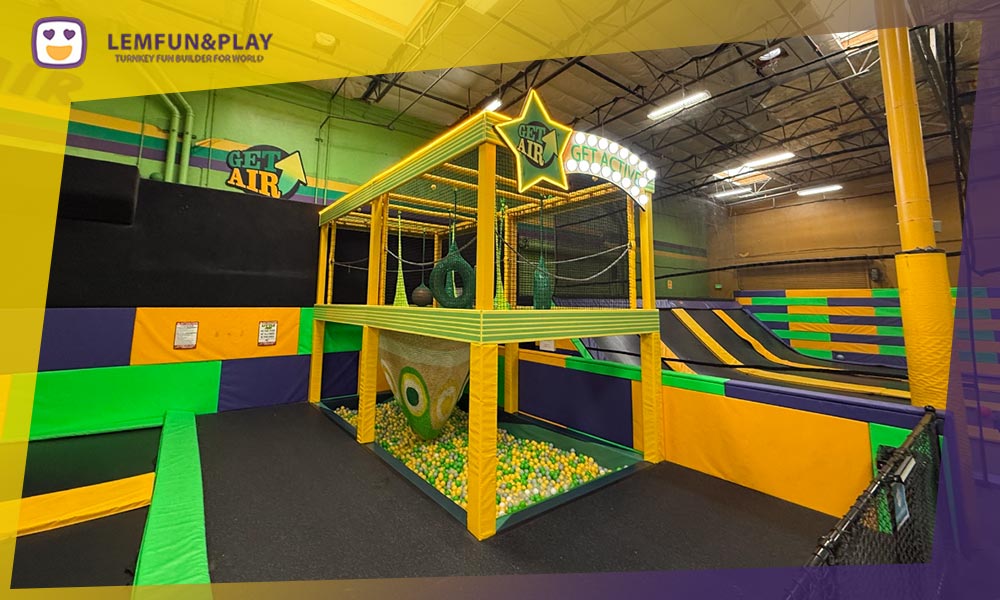
The frame is the only thing standing between a successful business and a structural collapse. Most investors never see the frame once the padding is installed, which is why dishonest factories love to cheat here.
We use galvanized steel pipe. Not "spray-painted" steel—hot-dip galvanized.
Vertical Columns: 80mm x 80mm with a 2.0mm wall thickness.
Horizontal Cross-beams: 40mm x 80mm with a 2.5mm wall thickness.
Why the difference? The cross-beams take the direct impact of the springs. They need that extra 0.5mm to prevent "bowing" over time.
A factory trying to win your business on price will use 1.5mm or 1.8mm steel. On day one, it feels fine. By month six, the frame begins to "sing"—it squeaks and groans. By month twelve, the welds begin to hairline crack. Once the frame is compromised, the entire park is a write-off. You cannot "patch" a weak skeleton.
When you look at trampoline commercial pricing, demand the steel mill's certification. If they can’t provide a thickness gauge reading, they are hiding something.
4. Compliance, Fire Codes, and the "Western Market" PremiumIf you are building in the United States, United Kingdom, Canada, or Australia, your "equipment cost" is fundamentally different from someone building in a market with no regulations.
To pass an inspection in these regions, every component—from the thread in the netting to the foam in the pits—must be Fire Retardant (FR).
ASTM (USA) and EN1176 (Europe) aren't just labels; they represent a different tier of raw materials.
The Cost Jump: Using certified FR materials and anti-static netting will increase your equipment quote by 30% to 60%.
I’ve seen clients try to "sneak" non-certified equipment into the UK. The fire marshal shows up, does a "match test" on a piece of foam, and shuts the building down on the spot. Now the owner has $100,000 of useless plastic and steel sitting in a locked building while they still have to pay $10,000 a month in rent. Do not play games with compliance. If you are in a regulated market, pay the premium. It is cheaper than a permanent shutdown.
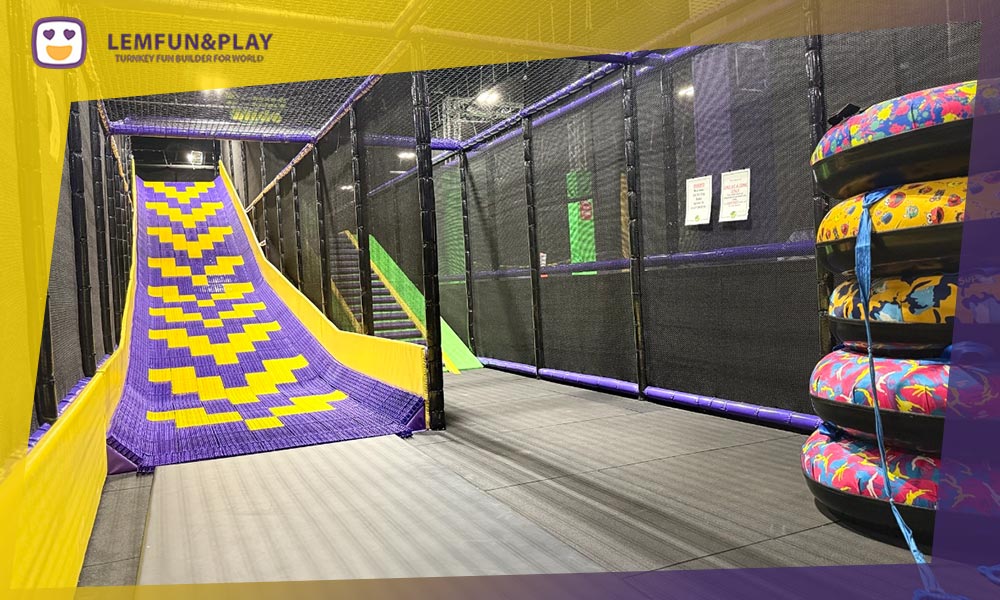
I’ve had investors come to me with a signed 10-year lease for a beautiful building with a 4-meter ceiling. My heart sinks for them.
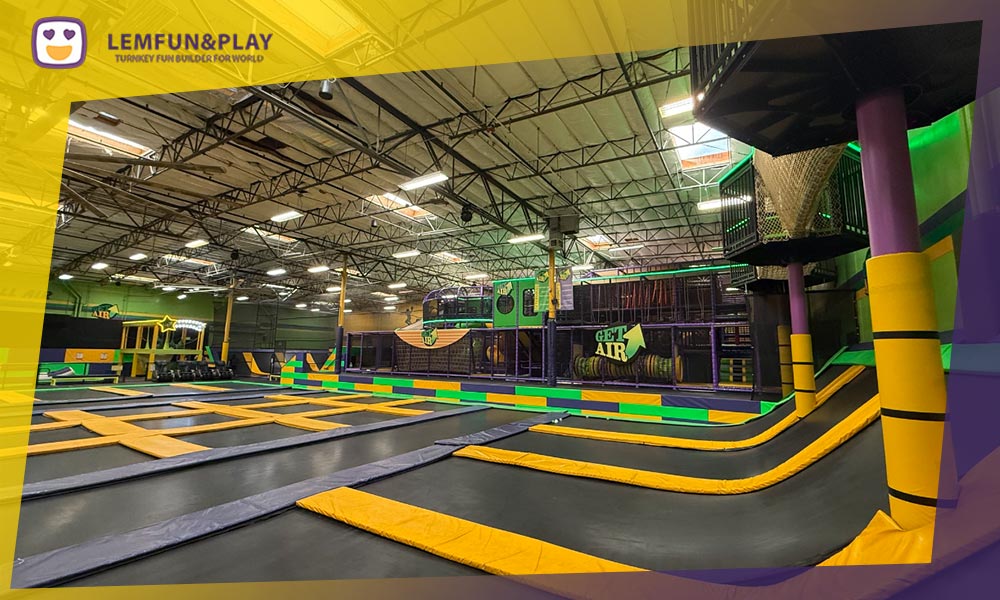
If your ceiling (clear height, below the beams) is less than 4.5 meters, you cannot build a modern, multi-tier trampoline park. You are stuck with a "flat" park. Flat parks are for 2015. In 2026, you need verticality.
High-ROI items like Ziplines and Ropes Courses require specific "Dynamic Height."
The Drop: A zipline needs a 3% to 6% slope to function. If your run is 30 meters long, you need a significant drop.
The Clearance: You need a 1.8-meter (6 foot) "No-Go Zone" below the zipline.
The Math: If your zipline starts at 5 meters and drops to 3 meters, you can’t put any other equipment underneath it.
If your facility is 6 meters or higher, you can "double-stack" your revenue. You can have a trampoline area on the floor and a ropes course in the "air." This effectively doubles your square footage without increasing your rent. This is how you win the ROI game.
6. Installation: Why a "Local Handyman" is Your Worst EnemyYou’ve spent $150,000 on high-end equipment. Now, how are you going to put it together? This is where many owners try to save $10,000 and end up losing $50,000.
Guided DIY: We provide a 100 page technical manual in English. You hire local contractors. This works only if your contractors have experience with steel tensioning.
Factory Engineers: We send 2 to 3 expert engineers from our factory. You pay for their flights, visas, $150-$200 daily salary, and basic accommodation.
I once saw a project in New Jersey where the owner hired local "general builders." They didn't understand the tension requirements for the main jump mats. They over-stretched the springs using a truck winch because they couldn't get them on by hand. By the time they were done, they had warped the 2.5mm steel frame.
The result? The park was unsafe, and they had to pay for us to ship new frame sections and send our own team to fix it. Their "saving" cost them an extra month of rent and $20k in repairs. Installation is the final 10% of the project, but it carries 90% of the structural risk.
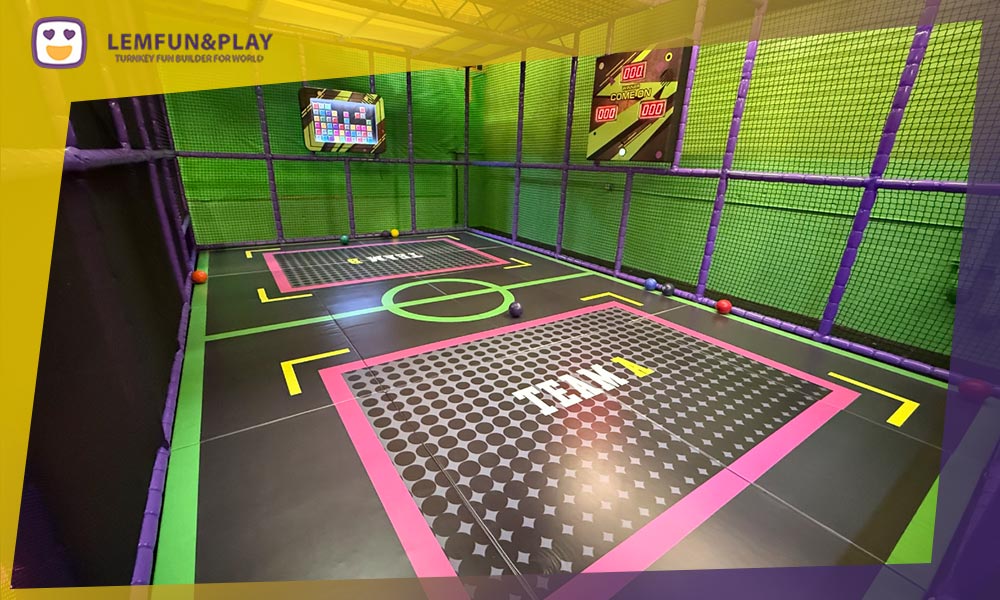
If you fill 100% of your space with trampolines, you will go bankrupt. Why? Because kids don't pay the bills; parents do. And parents want a place to sit, drink a $5 latte, and watch their kids from a safe distance.
A veteran playground equipment manufacturer will tell you to follow the 7:3 Ratio:
70% Play Area: Trampolines, Ninja Course, Foam Pits.
30% Non-Play Area: Cafe, Reception, Lockers, and—most importantly—Party Rooms.
Birthday parties are the lifeblood of this industry. A 20sqm party room can generate more profit per hour than 200sqm of trampolines. Why? Because it’s a package deal. You are selling pizza, drinks, and "exclusivity."
In terms of budget, the construction of this 30% area (counters, tables, decor, kitchen equipment) usually costs about 20% to 30% of what you spent on the play equipment. If you spend $100k on trampolines, keep $30k in the bank for the "parent experience."
8. Maintenance and the "War Chest"The day you open your doors is the day your equipment starts to die. This is a high-impact business. Springs will snap. Mats will get cigarette burns (yes, it happens). PVC will get sliced by sharp zippers.
You must set aside 10% to 15% of your initial equipment cost every year as a maintenance and upgrade fund.
High-Traffic Reality: In a busy park (500 jumpers a weekend), you will be replacing 5% of your springs every six months.
The "Vibe" Factor: If you don't fix a small tear in a mat immediately, the foam inside will degrade. Within a month, that "small tear" becomes a $2,000 replacement job.
My Experience: The most successful owners I know are "maintenance hawks." They walk the floor every morning. They replace a spring the second it looks stretched. This keeps the park looking brand new for 5 years, while the "lazy" competition looks like a junkyard by year two.
9. Real-World Case Study: The Australian 500sqm ProjectLet’s look at the numbers for a mid-sized park we completed for a client in Brisbane.
The Venue: 500 square meters, 5.5m ceiling.
The Vision: A "Pro-Level" park with a Ninja Course and an Airbag.
Our Initial Equipment Quote: $118,000 (including high-density padding and 2.5mm steel).
Final "Landing" Cost: $134,500.
Shipping & Logistics: $7,000 (Ocean freight was volatile that month).
Import Duties/GST: $6,000 (Australia has strict tax and import protocols).
Onsite Engineering Support: $3,500 (The client opted for 2 factory engineers for 10 days).
The Lesson: The client was smart. He didn't panic when the "final" cost was 13% higher than the "equipment" cost. He had budgeted for a 15% variance. He opened on time, passed his safety audit on the first try, and was profitable by month seven.
Q: Can I save money by buying used equipment? No. It’s a liability nightmare. My Experience: You don't know the "stress history" of used springs or the bacterial load in used foam. Most insurance companies won't even touch a park with second-hand equipment. You’ll spend more on refurbishing it than buying new from a source factory.
Q: Why is your padding so much more expensive than the "other guy"? Because mine actually works. My Experience: The "other guy" is selling you EPE foam wrapped in thin 0.3mm PVC. It will look like a wrinkled mess in three months. I'm selling you a structural component that will handle 10,000 jumpers without losing its shape.
Q: Do I really need a Ninja Course? Yes. If you want to stay relevant. My Experience: Trampolines alone are becoming a commodity. The Ninja Course attracts the 12-18 age group—the "teen" market that spends more and stays longer. If you only have mats, you're just a daycare center.
Q: How long does it take from payment to opening? 4 to 6 Months. Don't believe anyone who says "6 weeks." My Experience: 30 days for design and production, 30-45 days for shipping, and 30 days for installation and local inspections. If you try to rush this, you will make mistakes that cost you thousands.


We use cookies to enhance your browsing experience, serve personalized ads or content, and analyze our traffic. By clicking "Accept All", you consent to our use of cookies.
