
Get You Updated on Playground Equipment News.
Putting your pen down and considering more about the venue If you are currently scouting for a location . As a experienced manager with 15 years at Lemfun, I have seen hundreds of investors fall in love with a building’s "location" or "cheap rent," but realizeing three months later that the building is a huge trap that kills their business.
In the field of indoor playground, your building is not only a frame but also the skeleton of your revenue. The business will certainly be crippled if this skeleton is deformed. You should not start with a shopping list of toys for answering the question "What do you need to open an indoor playground?" Trying to start with a tape measure and a structural engineer is a better choice.
As indoor play manufacturers, we don't just sell steel and foam ,but also selling ROI. And today's article is aiming to tell you the brutal truths about height, floor loads, and the invisible costs that most providers are too scared to mention.
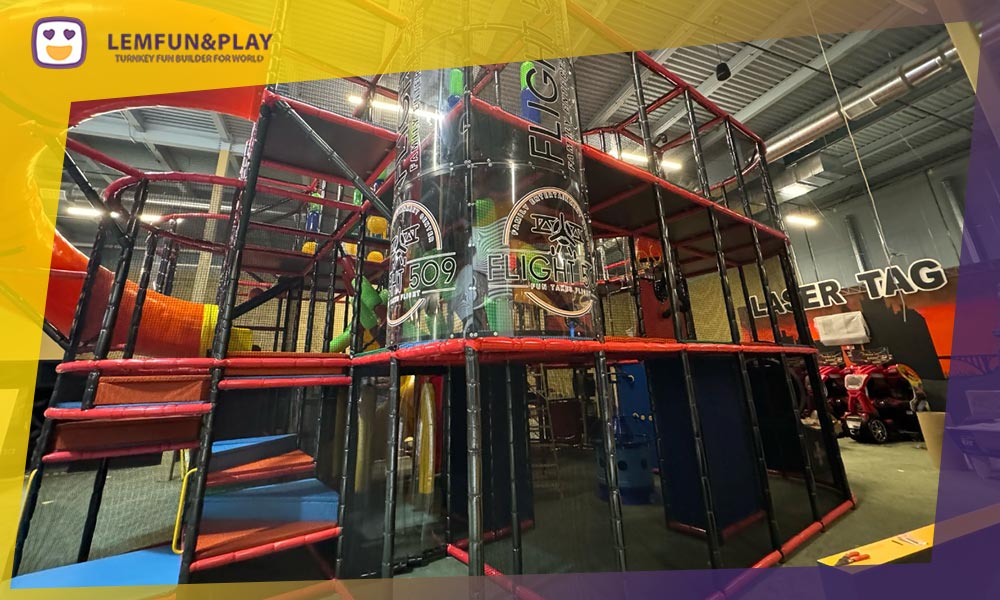
When I walk into a potential site, the first thing I look at isn't the square footage—it's the distance between the floor and the lowest hanging obstruction. In this industry, we trade in "Vertical Volume."
The 4.4-Meter Death Line
To build a world-class, 3-tier "Naughty Castle" using professional commercial indoor play area equipment, you need a minimum clear height of 4.4 meters (14.43 feet). This is not a "suggestion"; it is a calculation based on human safety and engineering standards.
The 1.4-Meter Standard: Each tier of a playground must be at least 1.4 meters tall. Why? Because this allows a child to stand up comfortably and an adult (a parent or staff member) to crawl through during an emergency or for daily cleaning. Anything less than 1.4m feels like a claustrophobic tunnel, and your customer retention will plummet.
The 20cm "Safety Gap": This is the gap between the top of our steel frame and your ceiling (or fire pipes). If you don't have this 20cm, we cannot physically install the top-level safety netting or secure the fasteners. We’ve had clients try to force us to build "tight to the ceiling," and we refuse. Why? Because without that gap, you can't inspect the top of the structure, and heat trapped at the ceiling will degrade your foam components twice as fast.
The 3.5-Meter "Pivot" Strategy
What happens if you’ve already signed a lease and the height is only 3.5 meters? In the eyes of many indoor play manufacturers, you are limited to a "toddler center." But at Lemfun, we use a "Visual Volume" strategy.
Instead of cramming three miserable levels into 3.5 meters, we build a 2-tier powerhouse. We increase the height of each level to 1.6 meters or even 1.7 meters.
The Logic: A 2-tier structure with high ceilings allows for much larger, faster slides and more complex climbing obstacles. It feels "grand" rather than "cramped." If you try to squeeze 3 levels into 3.5m, you end up with 1.1m per level. That is a recipe for lawsuits when a parent hits their head trying to reach a crying child.
2. The Profit Architecture: The 7:3 Golden Ratio
One of the most dangerous myths in the industry is that every square meter of your floor should be covered in commercial indoor play area equipment. Rookie owners look at a 500sqm room and want 480sqm of play equipment.
That is a suicide mission for your bank account.
After 15 years, I can tell you that a healthy facility operates on a 6:4 or 7:3 ratio.
60-70% Play Area: This is your "Magnet." It draws people in.
30-40% Non-Play Area: This is your "Money Maker." This includes the reception, the cafe, the party rooms, and the "Parental Sanity Zone."
The Canadian Case Study: Outsmarting the Competition
I worked with a client in Quebec, Canada, who was terrified because three other playgrounds were within a 10-mile radius. They were all 90% play equipment and 10% benches. Their business model was "Ticket Volume."
I told him: "Stop selling play. Start selling convenience."
We designed his 800sqm space with 300sqm dedicated to high-end party rooms and a full-service cafe.
The Result: While his competitors were fighting over $15 walk-in tickets, my client was booking $500 birthday parties. The "Non-Play Area" provided the highest profit margin in the building. Parents chose him not because his slides were longer, but because they could actually sit in a comfortable chair and drink a latte while their kids were safe.
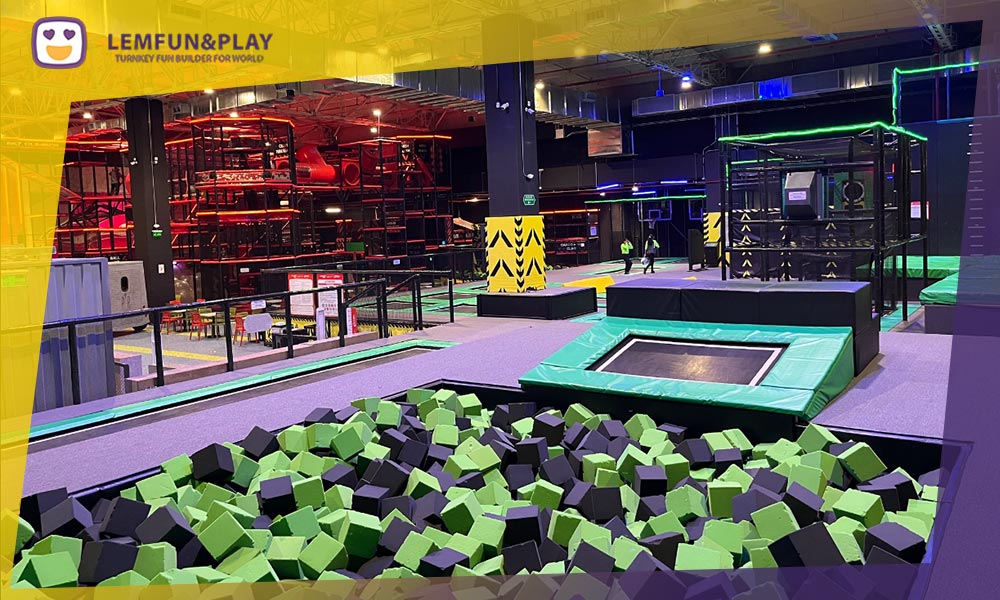
Most factory-made designs fail because they don't account for the reality of commercial architecture. You will have pillars. You will have HVAC ducts. You will have fire risers.
The Pillar "Asset" Strategy
A 60cm wide concrete pillar in the middle of your floor is a nightmare for a standard equipment supplier. For us, it’s an opportunity. We don't just "pad" it; we integrate it.
We use the pillar as a central axis for a 360-degree soft-play carousel or a vertical climbing wall. By wrapping these "dead spots" in high-density foam and 0.55mm PVC vinyl, we turn a structural obstacle into a safety feature.
Warning: Never attempt to drill into a pillar to "bolt" equipment. As a veteran manufacturer, we know this compromises building integrity. We use "friction-fit" and "clamping" systems that secure our equipment around the pillar without touching the concrete.
The HVAC & Fire Sprinkler Paradox
In many countries, fire codes require a clear path for water from the ceiling sprinklers. If your play structure has a solid plastic roof or "honeycomb" netting that is too tight, it will block the water.
We design our commercial indoor play area equipment with "Fire-Flow" paths. We typically leave 18 inches (approx 45cm) of clearance for sprinkler heads. If your building height is marginal, you need to know this BEFORE you order equipment, or the Fire Marshal will shut you down on your opening night.
4. The "Floor Load" Death Line: A Warning for Mall Investors
If you are opening in a shopping mall, an old department store, or any floor above the ground level, you are playing a dangerous game with gravity.
Standard commercial office floors are often rated for 250-350kg/㎡. This is fine for desks and people. It is catastrophic for a playground.
Static Load: A 3-tier steel playground structure with thousands of plastic balls, 20mm thick floor mats, and PVC cladding weighs tons.
Dynamic Load: You aren't just holding the weight of the steel; you are holding the weight of 50 kids jumping, running, and creating "impact force."
The Standard: For a professional playground, you need a floor rated for 500kg/㎡ to 600kg/㎡. If you are installing a "Ninja Warrior" course or a high-ropes expansion, you might need 800kg/㎡ at the load points.
My Experience: I have seen owners spend $100k on equipment only to find out the mall floor would "flex" under the weight. They had to spend another $40k on carbon-fiber floor reinforcements. Ask for the "Structural Loading Certificate" before you sign the lease.
"Hey, can we just add a 4th level to make it 6 meters high?"
As indoor play manufacturers, we can build as high as you want. But are you prepared for the "Cost Jump"?
Adding a third or fourth level isn't a linear price increase. It’s an exponential one.
Direct Equipment Cost: Going from 2 tiers to 3 tiers typically adds 25-30% to the price tag.
The "Hidden" Logistics Cost: Taller equipment means more steel, more volume. This translates to an extra 40ft High-Cube container in shipping. It means higher customs duties. It means your installation team needs scaffolding and specialized lifts, adding 10-15% to your labor costs.
Insurance & Compliance: In the US (ASTM) and Europe (EN1176), once you go over certain heights, your liability insurance premium can double. The safety testing required for "High-Fall" zones is much more rigorous. If you aren't a high-volume facility, that 4th level might actually lose you money in the long run.
6. Powering the Monster: The 500sqm Electrical Blueprint
You cannot run a modern indoor playground on a standard retail power outlet. I’ve seen projects delayed by months because the owner forgot to check the "Amperage" of the building.
For a 500sqm (approx 5,400 sq. ft.) facility, you should secure 60kW to 80kW of power. Here is why:
The HVAC System (40%): You are putting 50 to 100 sweaty, high-energy children in a confined space. If your AC isn't overpowered, the room will smell, the equipment will get "sticky," and parents will leave within 20 minutes.
Electric/Interactive Play (30%): Modern commercial indoor play area equipment includes interactive floor projectors, "Volcano" ball blowers, and rotating carousels. These motors draw a significant "surge" of power when they start up.
Ancillary Services (30%): Your cafe needs espresso machines, ovens, and refrigerators. Your front desk needs servers and security monitors.
If you don't have enough power, you will experience "Brown-outs" where your projectors flicker every time the AC compressor kicks in. It looks unprofessional and scares away customers.
I want to share a story about a client from London. He had a 600sqm warehouse and was ready to wire me $150,000 for a massive trampoline and soft-play combo.
I looked at his site photos and his survey, and I told him: "Keep your money. I won't sell to you."
He was shocked. Most indoor play manufacturers would have taken the money and run. But at Lemfun, we know that a failed client is bad for our reputation.
His venue had three fatal flaws:
The Height Illusion: The roof peak was 4.5m, but the "Steel Portal Frames" (the beams holding the roof) crossed the room at only 3.6m. He thought he had a 3-tier space; he actually had a 2-tier space.
The Single-Exit Trap: The warehouse only had one "Roller Shutter" door. For a public assembly license, the Fire Department required three distinct "Means of Egress" (exits). The cost to cut two new fire exits through the reinforced concrete walls was going to be $45,000.
No Fire Suppression: The building had no sprinkler system. In the UK, for a "High-Combustible" child play area (foam/vinyl), this is a death sentence for your permit.
Because we did the math before the sale, he realized the "cheap" warehouse was actually a "money pit." He found a new location three months later—one with high ceilings and proper exits—and today he is one of our most successful European partners.
8. Navigating the "Paper Trail": ASTM, EN1176, and Your License
If you are in the USA, Canada, or Europe, you are not just buying "toys." You are buying a regulated piece of industrial equipment.
When you ask "What do you need to open an indoor playground?", the answer is: Documentation.
Material Certificates: Every piece of PVC must be fire-retardant. Every piece of foam must be non-toxic. If your manufacturer cannot provide these certificates, your local building inspector will make you tear the equipment out.
Structural Calculations: In earthquake zones (like California or Japan) or high-wind zones, your playground frame must be "seismically braced."
Third-Party Inspections: In many states, you cannot open until an independent safety inspector signs off on the installation. We design our equipment to pass these tests on the first try, saving you weeks of "re-work" and lost revenue.
Q: Can I save money by installing the equipment myself?
No. Only if you want to lose your insurance coverage. While you can technically bolt things together, a non-certified installation is a massive liability. If a child gets hurt and your equipment wasn't installed by a professional team or under factory supervision, your insurance company will refuse the claim. My Experience: We’ve seen "DIY" installations where the safety netting was installed with the wrong tension, creating "head-entrapment" hazards. Don't risk a child's life to save 5% on labor.
Q: Is it possible to run a playground without a cafe?
Yes, but your ROI will be 40% slower. You have to realize that you aren't just in the "play" business; you are in the "waiting" business. Parents are the ones with the wallets. If you don't give them a place to spend money while they wait, you are leaving thousands of dollars on the table every month. My Experience: A well-run cafe can cover the entire monthly rent of a playground facility.
Q: How long does the equipment actually last before it looks "trashy"?
With Lemfun quality, 8-10 years. With "cheap" alternatives, 2 years. The difference is in the "Skin." We use 0.55mm high-density PVC. Lower-end manufacturers use 0.40mm. Within 18 months of heavy use, the thin PVC will crack, exposing the foam. Once the foam is visible, it’s a health hazard and a fire risk. Invest in the "Skin" today, or pay for a total renovation in 24 months.


We use cookies to enhance your browsing experience, serve personalized ads or content, and analyze our traffic. By clicking "Accept All", you consent to our use of cookies.
