
Get You Updated on Playground Equipment News.
I talk to investors every day. Most of them are like you: you have the capital, you see the potential in the family entertainment market, but you are extremely short on time. You hate the hassle of dealing with twenty different vendors.
You want a business, not a construction site nightmare.
If you are thinking about starting a trampoline park in Canada, let me be brutally honest with you. The biggest risk isn't whether kids will like your park. The biggest risk is the Canadian government and the insurance companies.
I have spent 10 years in this industry. I have seen investors lose hundreds of thousands of dollars because they bought "cheap" equipment from a factory that didn't understand what a TSSA inspection was. They ended up with a warehouse full of steel and foam that they were legally forbidden to open.
I am not just a manufacturer. I am your project steward. Today, I’m going to share the real stories—the blood, sweat, and saved budgets—from my time on the ground in Montreal, Toronto, and Calgary.
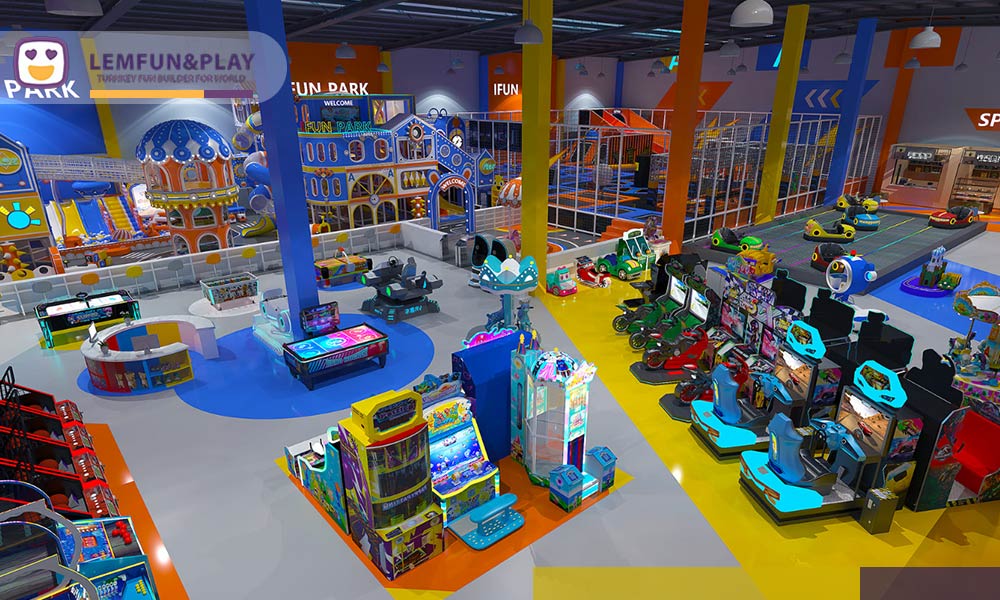
In Canada, specifically in provinces like Ontario and British Columbia, safety isn't just a suggestion. It is a rigid law. If your design doesn't pass the TSSA (Technical Standards and Safety Authority) review or the local Fire Code, you do not open. Period.
The “Beautiful” Design That Almost Got Demolished
I remember a client from Montreal. He came to me with a set of blueprints from a competitor. He was excited. He told me, "Bob, look at this. It’s beautiful. The play paths are amazing. I just want you to quote against this design."
I looked at the drawings. Aesthetically? Yes, it was pretty. But as a professional indoor playground supplier, I immediately saw a disaster waiting to happen.
I overlaid his building’s architectural drawings with the equipment layout. The result was shocking. The competitor’s design had placed a massive play structure frame right in front of two emergency fire exits.
The clearance between the steel frame and the exit door was less than 40cm.
In Canada, that is illegal.
If he had built that, the fire marshal would have walked in, taken one look, and ordered him to tear the entire structure down. That’s a delay of three months and a loss of $50,000 in installation costs, minimum.
I told him the truth. "This design is a trap. They didn't account for your building's constraints."
We redrew the entire plan. We modified the play routes. We cut specific structural sections and replaced them with soft play elements that didn't obstruct the flow. We solved the safety hazard without sacrificing the fun. The client didn't just thank me; he realized that "design" isn't just about colors—it's about legality.
The “Invisible Killer”: Insurance and the 1.2-Meter Rule
Investors often obsess over rent and equipment prices. But have you checked insurance premiums lately? In Canada, getting liability insurance for a trampoline park is becoming harder than getting a mortgage.
If your equipment doesn't meet ASTM or CSA standards perfectly, you will be blacklisted by insurers.
I had a client in Toronto who brought me a design he wanted to "upgrade." He liked it, but his gut told him something was off. He was right.
I analyzed his trampoline area. The foam pit depth was designed at 1.0 meter.
"Is that a problem?" he asked.
"Yes," I said. "In China, maybe not. But in Canada, and under strict ASTM standards, the safe depth for that type of jump is 1.2 meters."
A 20cm difference sounds small. But to an insurance adjuster, it’s the difference between a payout and a lawsuit that bankrupts you.
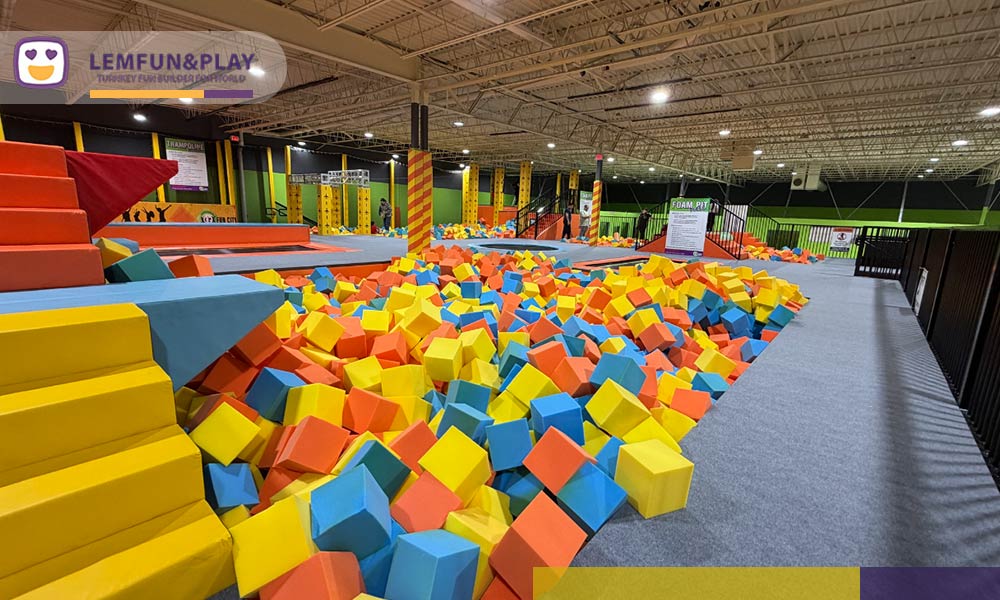
We didn't stop there. I noticed his basketball trampoline zone had no netting separating it from the foam pit. Kids could easily collide. We redesigned it immediately. We deepened the pits. We installed high-grade safety netting. We added impact-absorbing buffer mats at the slide exits.
The result? When the insurance inspector came, the facility passed with flying colors. We designed the risk out of the park, saving him thousands in annual premiums.
Mastering Government Relations (Zoning & Permits)
You want a turnkey solution? Real turnkey means handling the paperwork you hate.
In Canada, getting a Building Permit or a Use Permit is slow. It is painful. A standard factory will just ship you the goods and say "Good luck with the city."
At Lemfun, we start working on this before you even sign the lease. In the scouting phase, I help you review the venue. We check the sprinkler systems. We calculate the floor load capacity. We look at the zoning.
We don't just "sell gear." We arm you with the technical drawings and engineering stamps (P.Eng) you need to win the battle against the city bureaucracy.
Part 2: Construction is the “Mirror” of Your Budget
You might have heard horror stories about construction projects going 50% over budget. That happens when you deal with suppliers who treat "delivery" as the end of their job. For me, delivery is just the beginning.
The 15% Variance: Why I Refuse to Lie to You
I know how the industry works. Salesmen want your deposit. So, they give you a quote that looks low. They conveniently "forget" to mention the installation crew's accommodation, the forklift rental, the air quality testing, or the marketing launch costs.
They sell you a "6-month ROI" dream. It’s a "fishing project"—they hook you, and then the price goes up.
I don't play that game. Starting a trampoline park in Canada is expensive. I list every hidden cost I can foresee. My initial budget might look higher than the other guys, but my final budget variance is consistently under 15%.
When I present the real numbers, my clients—who are smart business people—don't get scared. They get relieved. They tell me, "Bob, thank you. I didn't think I could make my money back in 3 months anyway. I prefer the truth."
The "Last Mile" Crisis in Calgary
Logistics is where projects die. You have a grand opening date set. The Mayor is coming. And then, a container gets stuck, or a part breaks.
Let me tell you about a project in Calgary. The goods arrived, but during the inland transport, a critical zipline frame component was smashed. It was destroyed.
The opening was in two weeks. A standard supplier would say, "File a claim with the shipping company, we will send a new one by sea in 40 days."
I didn't do that. I am a Project Steward. The moment I got the photo of the broken part, I called my factory. We halted the production line. We manufactured a custom replacement that same afternoon.
I didn't put it on a boat. I paid for international air freight out of my own pocket to fly that heavy steel part to Calgary.
It arrived in 3 days. The installation finished on time. The client didn't have to stress for a single minute. That is what "Turnkey" actually means.
When Chinese Manufacturing Meets Canadian Electricians
Here is a cultural clash you might not expect. Canadian tradespeople—especially certified Electricians—are expensive, highly skilled, and sometimes, very difficult to work with. They often look down on imported equipment.
If your interactive games don't match Canadian voltage or if the wiring isn't clear, the local electrician will refuse to touch it. They charge by the hour, and they will bleed your budget dry while they figure it out.
How do I solve this?
Preparation: In the production phase, we double-check the voltage, the electrical interfaces, and the ironwork standards to match CSA requirements.
Communication: I provide installation manuals in perfect English, supported by video guides.
We bridge the gap between the factory floor and the Canadian job site, so you don't have to play translator.
Part 3: Operational Vision – Making Money in a High-Cost Market
Labor in Canada is expensive. If you need a staff member to watch every single corner of your park, your payroll will eat all your profit.
The “Foolproof” Layout Strategy
I had a client in Ontario with a 1,300 square meter venue. He was terrified of labor costs. He told me, "I don't want to hire an army to watch this place."
I looked at his layout. It was fragmented.
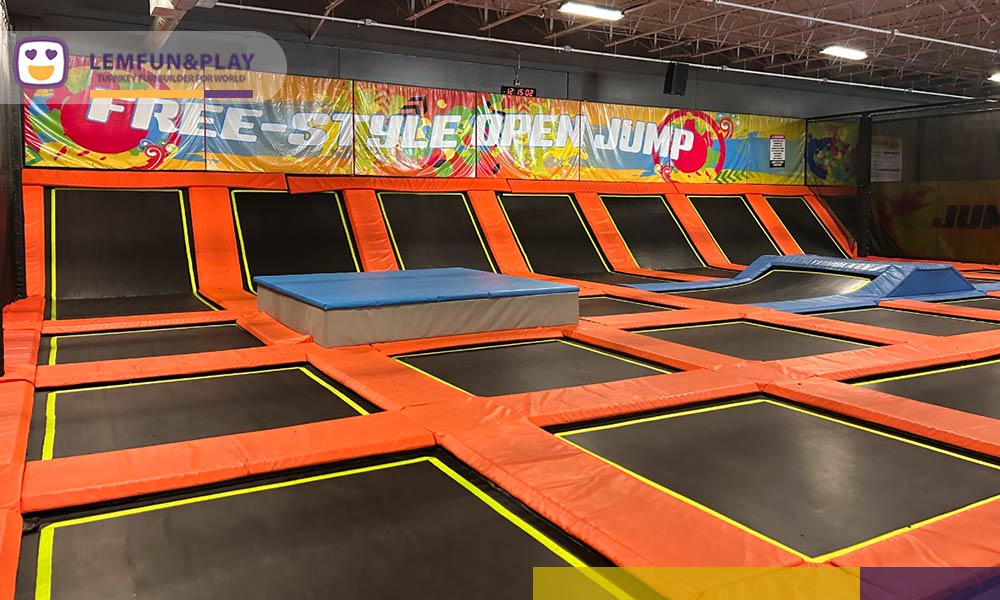
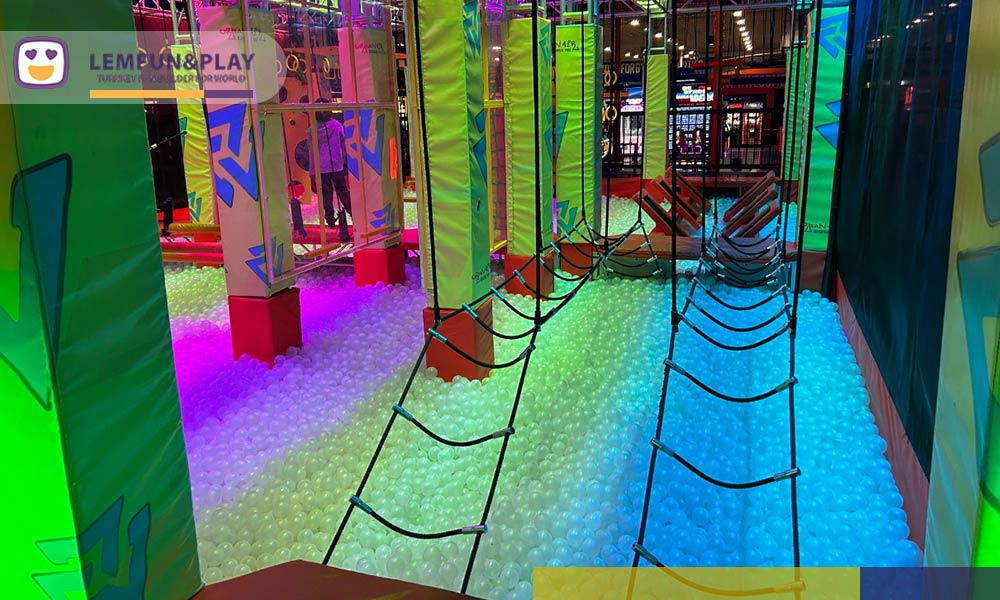
My solution? We physically connected the Trampoline Zone, the Ninja Course, and the Indoor Playground Structure using ball pits as the connector.
This created a "closed loop." Kids could flow from one area to another without walking on the main floor.
The result: He only needed one or two staff members to monitor three huge zones. The sightlines were clear. The maintenance was easier because the spaces were accessible.
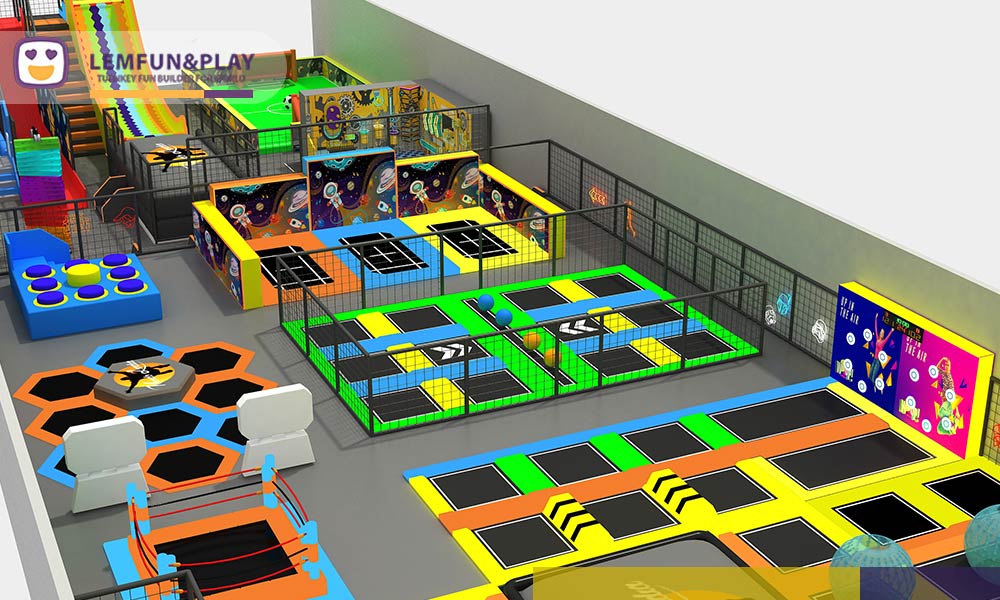
Good design isn't just about fun; it's about reducing your monthly payroll.
Do You Really Need to Be an FEC? (The Quebec Case)
A client in Quebec called me, panicked. "Bob," he said, "Two huge Family Entertainment Centers (FECs) just opened within 3km of me. They have high-tech VR, bowling, everything. Should I buy expensive gear to compete?"
I looked at his market. The other guys were charging high ticket prices to cover their expensive equipment.
I advised him: "No. Do not copy them."
Instead of turning his park into a confused mess of gadgets, we focused on High-Efficiency Operations.
Differentiate: We kept the trampoline park trampolines for sale classic but added interactive projection games. Low cost, high engagement.
Revenue Model: We redesigned his lobby to focus on Group Buying and Birthday Parties.
He didn't need a million dollars of VR gear. He needed a better party room and a smarter pricing strategy. Today, his park is the most profitable in the area because his overhead is low, and his "Cost Per Play" is unbeatable.
Squeezing ROI from Every Inch
You are paying rent on every square foot. Why leave the air empty?
For a 1,250 sqm project, I used vertical space to maximize revenue.
We placed the Rope Course directly above the Ninja Course.
We integrated soft play games onto the structure of the playground.
We forced space for a Café and dedicated Party Rooms.
Yes, building a kitchen costs more upfront. But a parent drinking a $5 latte while waiting for their kid is pure profit. A birthday party room generates revenue even when the park is empty.
I don't just design for kids; I design for your bank account.
If you want the cheapest price, go to Alibaba. You will find plenty of factories willing to sell you a container of metal.
But if you are the type of investor who values your time, your reputation, and your legal safety, you need more than a factory. You need a partner who understands the Canadian market.
I promise you this: My equipment will never be the reason you get sued. My designs will never be the reason your permit is denied.
When you choose Lemfun, you are choosing a 10-year veteran who acts as your shield against the chaos of construction.
Ready to build a compliant, profitable park without the headache? Let’s talk.
FAQ: Common Questions About Starting a Trampoline Park in Canada
The honest answer is between $400,000 and $1,000,000 CAD, depending heavily on your location and renovation needs.
While the equipment itself might cost $150k-$300k, investors often underestimate the "invisible" costs: HVAC upgrades, sprinkler systems, TSSA registration fees, and local permits. At Lemfun, I provide a comprehensive budget breakdown that includes these construction realities so you aren't blindsided halfway through the project.
Yes, if you are in Ontario or BC, operating without it is illegal and will shut you down.
The TSSA (Technical Standards and Safety Authority) is extremely strict. Many foreign suppliers claim their gear is "safe," but they don't have the engineering dossiers required for a Canadian review. As an experienced indoor playground supplier, I ensure every drawing I submit is ready for a P.Eng stamp to pass these inspections smoothly.
Insurance companies are rejecting parks that fail to meet specific ASTM standards, such as foam pit depth.
I’ve seen parks rejected because their foam pits were 1.0m deep instead of the required 1.2m. To lower your premiums, I design strictly to ASTM F2970 standards—including proper netting, redundant padding, and documented maintenance logs—which proves to insurers that your facility is a low-risk investment.
Realistically, plan for 6 to 9 months, with most of that time spent on permits, not manufacturing.
Manufacturing the trampoline park trampolines for sale only takes about 30 days. Shipping takes another 30-40 days. However, obtaining Building Permits and Change of Use permits in Canadian cities can take 3-5 months. I use this "waiting time" to finalize production so that the moment you get your permit, my installation team is ready to deploy.
I don't just help you find them; I can send my own supervisors or guide your local team.
Local labor is expensive (often $60-$100/hr for skilled trades). To save you money, I provide detailed, bilingual 3D installation manuals and video guides. This allows you to hire general laborers for the heavy lifting while my lead engineer guides them remotely or on-site, ensuring the equipment is installed correctly without paying "expert rates" for simple tasks.


We use cookies to enhance your browsing experience, serve personalized ads or content, and analyze our traffic. By clicking "Accept All", you consent to our use of cookies.
