
Get You Updated on Playground Equipment News.
Hello everyone. I’m Bob,the Sales Manager from Lemfun.
Over the last decade in the indoor playground industry, I have spoken with countless clients and heard their dreams. I have checked their budgets. Unfortunately, I also have found many of their indoor trampoline park step into financial and operatinal disasters and even break down.
The factor is that the process of setting up a successful indoor play center is full of hidden traps. There are so many articles you read online will tell yousome useless noise like finding a crowded place or buying colorful attractions.
Today, I am going to share these secrets with you by showing you the exact mistakes that bankrupt investors in their first year. And then, I will tell you about the methods of avoiding these risks, which we found in these years' work.
Before signing a lease or buying a single venue, what you need to do is understanding the three most dangerous traps in this industry.
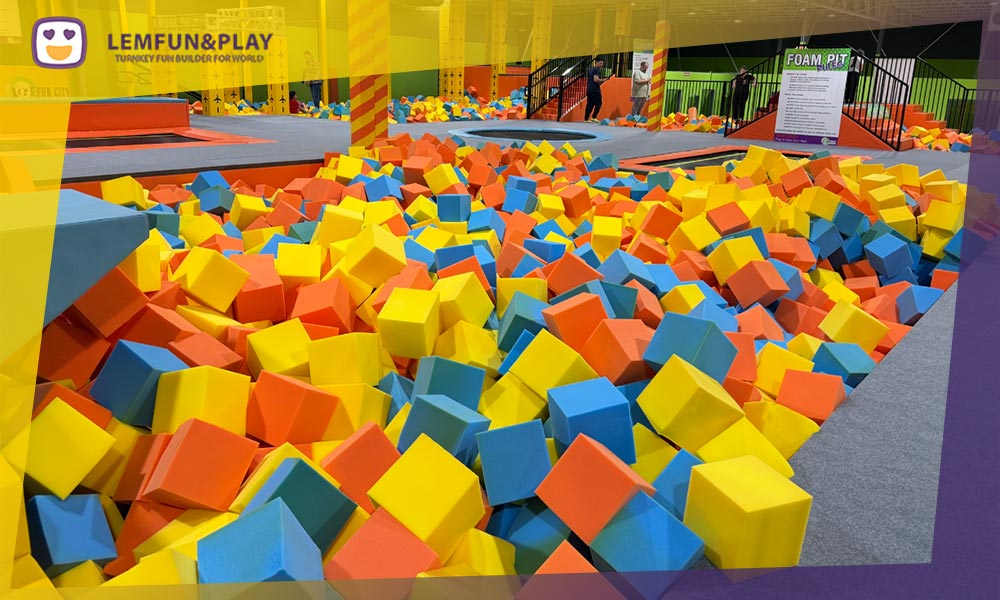
After going through a nightmare,a client from New York found us for an inquiry. He was in the site-selection phase. A local real estate agent sweet-talked him into renting a 4,000-square-foot warehouse at a suspiciously low price. The client wanted to open a small indoor park. Everything looked great apparently.
Then, during the engineering drawing phase, the team he hired caught a clear but fatal flaw. The building's ceiling was under 16 feet. But the local regulations in his area claimed a minimum of 16 feet for commercial jumping structures. The entire project had to be scrapped due to this mistake. He lost time, money, and had to start from beginning again.
I used to got a urgent call from a client in Kansas. What he needed is to hire my team to completely rebuild his park. Due to a wrong decision a year earlier, which he tried to save money, buying a set of cheap equipment from another unreliable supplier.
Within 12 months, the main metal frames were cracking. The plastic parts were snapping. The foam padding was disintegrating.Taking this safety hazard in to consideration, he could no longer trust the original manufacturer.
Therefore, he had to hire Lemfun to clean up the mess. If you want a business that has long lifespas, investing in high-quality commercial trampoline equipment is not optional but your lifeline.
This is the dirtiest trick i had met in my career. A client was manipulated by a competitor into buying a massive, ultra-expensive trampoline park setup who just wanted a big profit of the equipment.
When the client hesitated about the huge price tag and can't make a decision, the supplier quickly fabricate an ROI calculation. It looked amazing and attractive, for promising the client would make all his money back in just a few months. But, actually, it was a lie.
The result was brutal ,for the foot traffic of this trampoline park was average. What worse,the supplier never told the customer about the massive costs of equipment maintenance, local advertising, and staff payroll. The client was bleeding cash, and earning money even became a bubble.
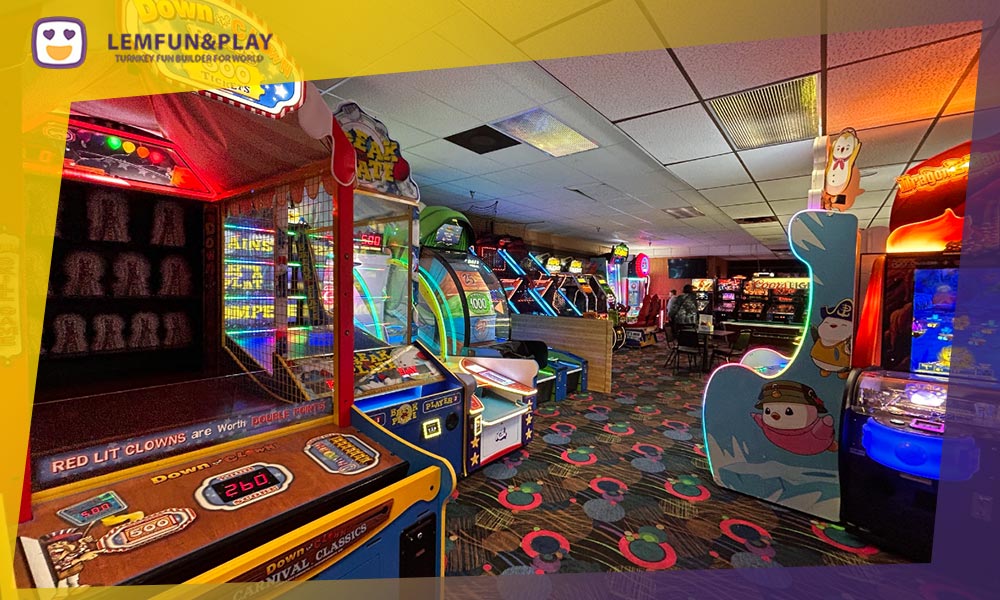
Most people believe that finding a good location means finding a busy street only. And that thought is compeletely wrong.
At Lemfun, we use a strict "Point-Deduction System" to evaluate venues owned by customers. So many people only look at potential foot traffic,as ignoring the building's physical limits. There golden locations had become a money pit finally.
The Hard Metrics is the Immediate Dealbreakers
Our hard metrics are the physical facts of the Venue. Such as Ceiling height,Load-bearing capacity, Rent costs and Physical location. In the US market, the demands of commercial venue are incredibly strict and the cost of leasing them are also high.
What's more, many local General Architects don't understand the specific fire codes for indoor amusement parks, for sometimes overlooking the special amusement building clauses in NFPA 101.
Let me tell you a story about a client from Arizona. He came to me with a blueprint of his venue in a large commercial center. "Bob!" he said, "Hurry up and design this! I will open my second trampoline park in this place!" He was almost holding the pen to sign the lease when he found me.
But I didn't obey his command immediately. Instead, I told him to wait for the inspection of my team. We investigated the site through checking the blueprint innitially, and we found two massive flaws of this venue:
The building had no original fire sprinkler system, and adding a brand new one would cost a lot of money. But he would never pass safety inspections without such a system.
Another flaw was that his venue only had one emergency exit. In such a high-density, high-noise amusement park, useing the only emergency exit means a stampede risk and highly illegal.
We told him about the truth and he cooled down soon. We finally let him dropped the pen to find another venue for his business. He was grateful to us, because he almost signed a lease for a useless warehouse.
I can tell you that a money-making trampoline park usa usually has three critical elements:
It is surrounded by young families with kids.
It has easy traffic access and its own dedicated parking lot.
It sits in a "blue ocean"—an area with few direct competitors.
However, commercial flow within a building is also a important matter for setting up a trampoline park.
A client from Louisiana provided us with a floor plan for a space inside a multi-story mall. He wanted a design of trampoline park right away.
We looked at the plan and rejected his location. His chosen shop was on the absolute highest floor, tucked away in the furthest corner. Worse, it was a massive walk from the mall’s only ground-level parking lot. Think about it. Parents carrying toddlers, diaper bags, and winter coats do not want to hike up four floors.
We advised him to negotiate for a lower-floor unit closer to the parking lot. He listened, avoided a massive drop in foot traffic, and his business is thriving.
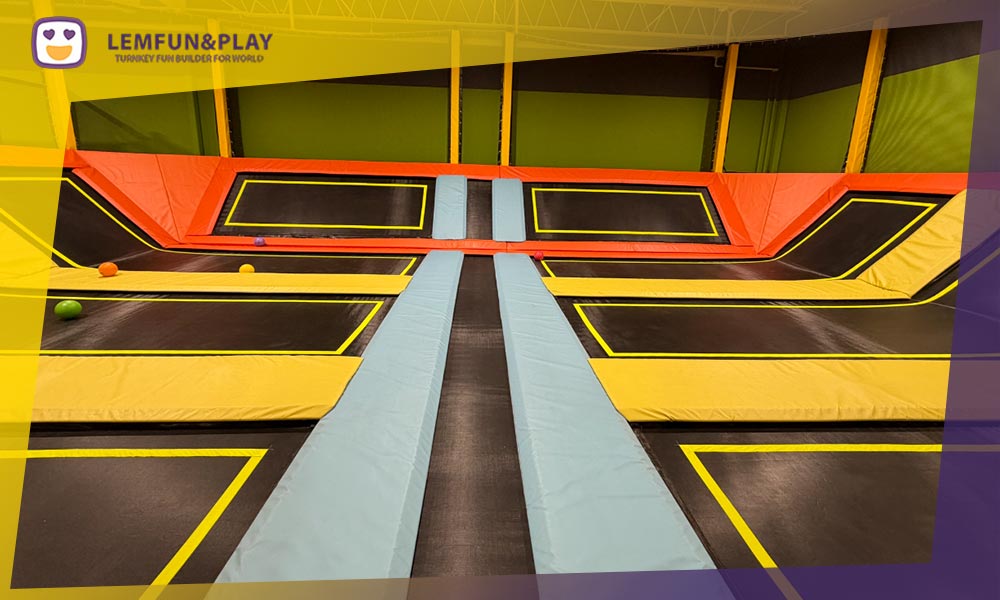
Walk into any park today, and you see the same things. Dodgeball. Foam pits. Slam dunk lanes. It is heavily homogenized. Because of this, clients panic. They think they need to buy the craziest, most expensive attractions to stand out.
As a Turnkey Solution Provider, our job is to make you money, not just sell you steel and foam. Sometimes, that means protecting you from your own ideas.
2.1 The Danger of Over-Design
Clients who handle things alone often make terrible decisions. We prefer clients who let us handle the entire process. We want to earn your money by providing mature, high-quality services. This builds trust.
But it also means we must intervene when you make a mistake.
A client from New Jersey reviewed our initial 3D design and frowned. "I need more thrills," he said. "I want to add a high-altitude zipline circling above the trampoline courts."
I gave him a hard, flat "No."
His building only had an 18-foot ceiling. Our professional trampolines have a very high bounce limit. If teenagers are bouncing high into the air, a zipline cutting across their airspace is a catastrophic safety hazard. We explained the physics and the liability risks. Faced with a firm but logical refusal, he dropped the unrealistic idea. Today, his park runs safely and smoothly, exactly as we planned.
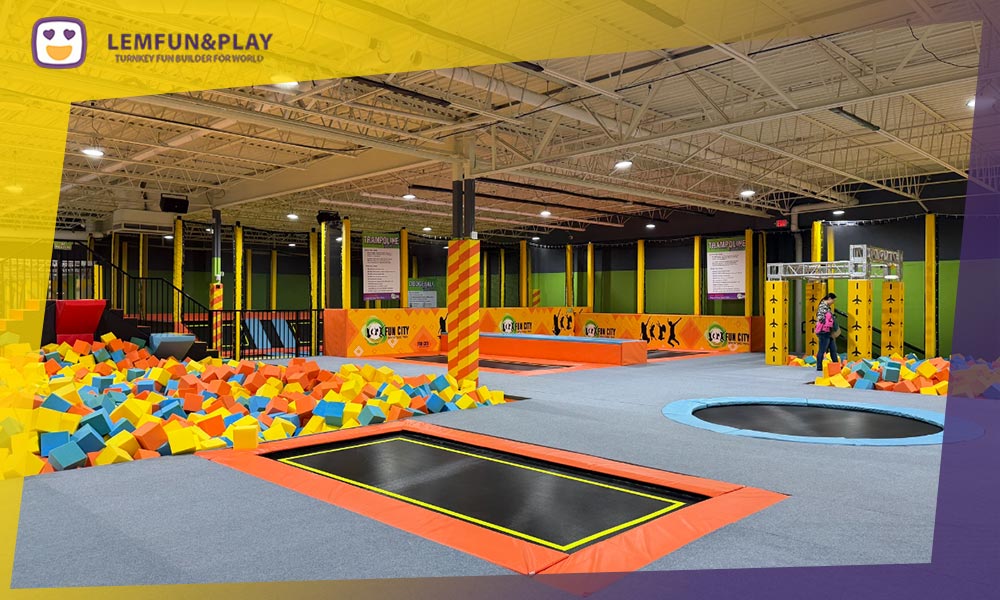
Visual Placeholder: A safety diagram showing the upward bounce trajectory of a high-performance trampoline, highlighting the "Red Danger Zone" where a zipline would cause severe collisions.
2.2 True Differentiation: Micro-Innovation & Smart Operations
You don't need to turn your park into a massive Family Entertainment Center (FEC) to win.
A client from West Virginia called me, stressed out. "Bob, two new FECs just opened within 3 miles of me. Their equipment is dazzling. Their tickets are expensive. Should I buy crazy new rides to fight them?"
I gave him two pieces of advice:
Differentiate through Operations: Don't fight them on luxury. Fight them on value and community. We focused his business model on group buys, school events, and high-volume Birthday Parties.
Micro-Innovations: Instead of buying huge mechanical rides, we upgraded his existing setup. We added interactive trampoline video games and projector-based basketball hoops.
This kept his costs low while keeping his park fresh and exciting. He maintained his price advantage. Right now, he is the most profitable operator in that 3-mile radius.
Visual Placeholder: A comparison table. Column A: "Heavy FEC Equipment Upgrade" ($200k cost, high maintenance, slow turnover). Column B: "Lemfun Interactive Trampoline Tech" ($30k cost, zero mechanical maintenance, high player turnover and retention).
Module 3: The Brutal Truth About ROI (Return on Investment)
Every commercial investment comes down to the ROI calculation. I understand why some manufacturers draw a massive pie in the sky to win a contract. They exaggerate daily foot traffic. They conveniently "forget" to mention hidden operational costs like marketing, staff wages, and deep cleaning fees.
This trick works to get a quick signature. But what happens a year later? When the client is losing money, trust collapses. They leave terrible reviews. How can a manufacturer survive in this market acting like that?
At Lemfun, we have a rule: Either do the math right, or don't do it at all.
3.1 The Hidden Costs of the US Market
Opening a park in America is not like opening one in other regions. The costs and hidden risks are much higher. You have to navigate strict fire safety systems so your project doesn't get frozen by inspectors. That is a massive hidden cost.
Furthermore, labor costs in the US are high. Insurance premiums for active amusement centers are incredibly expensive. Legal liability protection is mandatory. If a supplier hands you an ROI sheet that doesn't heavily factor in US wages and insurance, throw it in the trash.
3.2 Calculating Reality
When we calculate an ROI, we do our homework. We research your specific local market. We ask about your local minimum wage. We factor in realistic foot traffic, not holiday peaks. We put all the hidden costs on the table.
We admit that we cannot predict every single variable, so our ROI is a realistic reference, not a magical promise.
When we present these honest numbers, clients often take a deep breath and smile. They tell us, "Thank you. I knew I wouldn't make my money back in three months. Thanks for treating me like an adult."
Visual Placeholder: "A Realistic Monthly P&L Statement for a 6,000 sq ft US Park". Rows include Gross Revenue, minus US Labor, Liability Insurance, Local Marketing, Equipment Maintenance, and Rent, showing a realistic 14-20 month payback period.
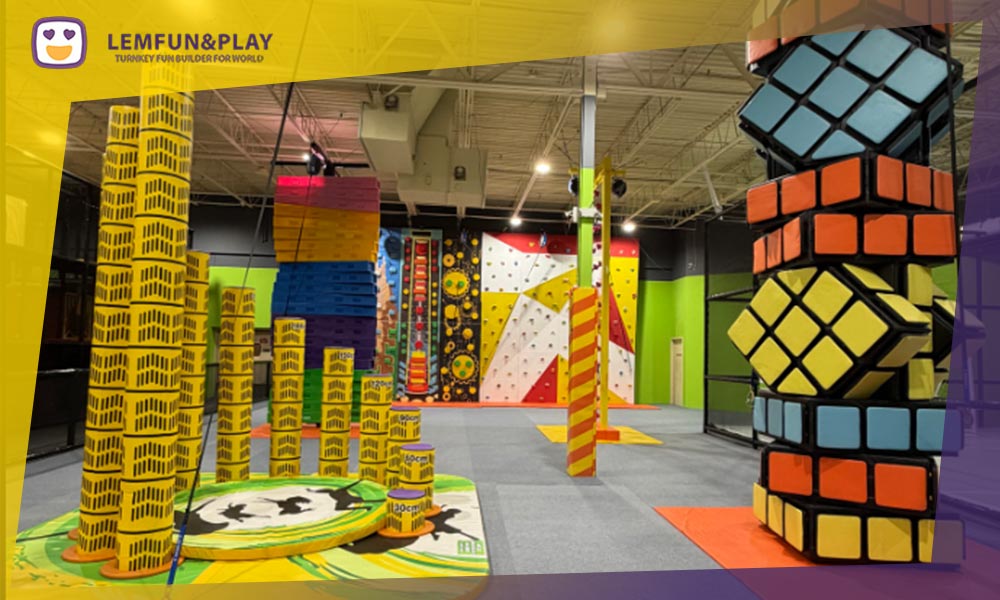
I meet clients all the time who hate dealing with multiple vendors. They lack the energy and experience. When they try to handle site selection, equipment purchasing, import customs, installation, and fire inspections by themselves, they make terrible, expensive decisions.
That is why having a true trampoline park contractor is vital. As a Turnkey Solution Provider, our goal isn't just to sell you equipment. Our goal is to use our mature, high-quality services to guide you past the traps, secure your trust, and launch a business that actually makes money.
Don't guess with your life savings. Let the veterans handle the heavy lifting.
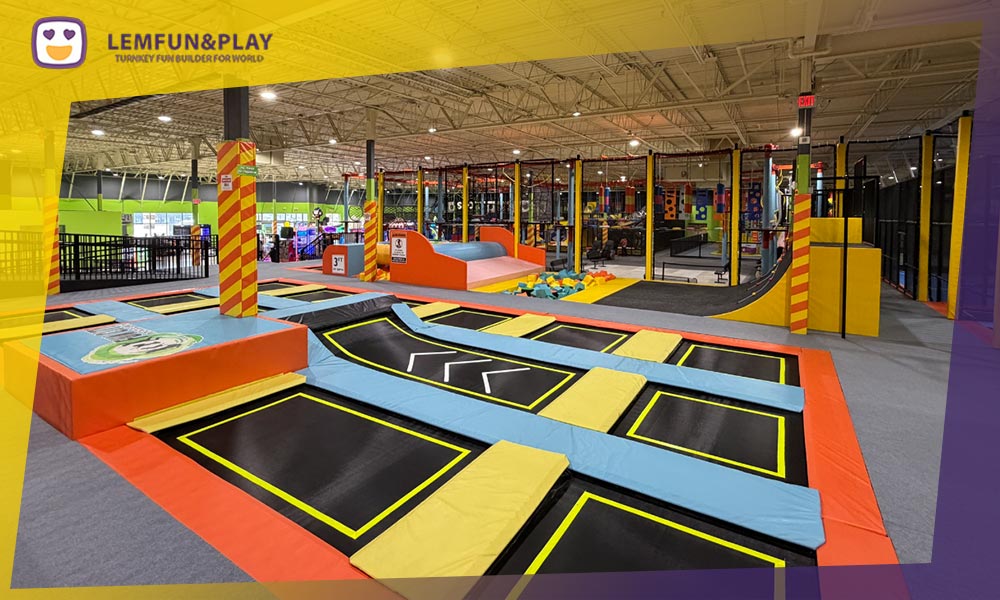
Q1: Should I always choose the busiest mall location for my new park?
Absolutely not; a busy mall location is a death trap if it lacks proper parking or fails basic building requirements.
As I tell my clients, foot traffic means nothing if families can’t easily access your front door. If your space is on the top floor at the far end of a mall, parents carrying kids and diaper bags simply won't make the walk. Furthermore, busy commercial spaces often have low ceilings. If your building isn't at least 18 feet high, professional trampolines become a severe safety hazard. We always judge a location by its physical hard metrics first, not just the crowds outside.
Q2: Why shouldn't I just buy the cheapest equipment available to lower my startup costs?
Cheap equipment will end up costing you double in replacements and lost business within your first year.
I had a client in Kansas who learned this the hard way. He bought budget gear, and within 12 months, the steel frames were cracking and the safety pads were destroyed. He had to shut down sections of his park and hire my team to completely rebuild it. In the US market, liability and safety are everything. Investing in premium commercial trampoline equipment from day one isn't an expense; it’s an insurance policy for your business reputation.
Q3: How long does it really take to see a return on investment (ROI)?
Anyone promising you a guaranteed 3-to-6 month ROI in the US market is lying to your face.
Many suppliers only calculate your gross ticket sales against the equipment cost. They deliberately hide the massive operating expenses specific to the US, like high hourly labor wages, heavy liability insurance premiums, marketing budgets, and daily maintenance. Based on our real-world data, a well-run park in a good location usually takes a much more realistic timeframe to break even. We prefer to give you the brutal truth before you sign, rather than a pleasant lie that bankrupts you later.
Q4: Can I handle the installation and fire safety inspections by myself?
Trying to manage multiple local contractors and complex fire codes without industry experience is the fastest way to delay your opening by months.
American fire codes, specifically NFPA 101 for special amusement buildings, are incredibly complex. Local architects often don't understand the high-noise, high-density requirements of a trampoline park. I've stopped clients from renting buildings that lacked the proper sprinkler systems or emergency exits. When you hire a turnkey provider, we manage the customs, the installation frameworks, and ensure the design meets strict inspection standards so you can actually open on time.


We use cookies to enhance your browsing experience, serve personalized ads or content, and analyze our traffic. By clicking "Accept All", you consent to our use of cookies.
