
Get You Updated on Playground Equipment News.
Frankly,if you are reading this article, you probably have the capital, but you don’t have the time to waste.
What you need is a trampoline park business plan that actually works, instead of a long page document full of fluff.
I have spent the over 10 years as a "project housekeeper" for investors , and I’ve seen beautiful parks fail because the calculation was wrong, and so many mediocre parks make millions with the reliable operational logic.
As a Turnkey Solution Provider, we don’t just sell equipment. we also sell a profitable operational model.
Today, I will strip away the marketing jargon and teach you how to create a profitable plan by using real lessons we learned the hard way in Portugal, France, Switzerland, and Austria.
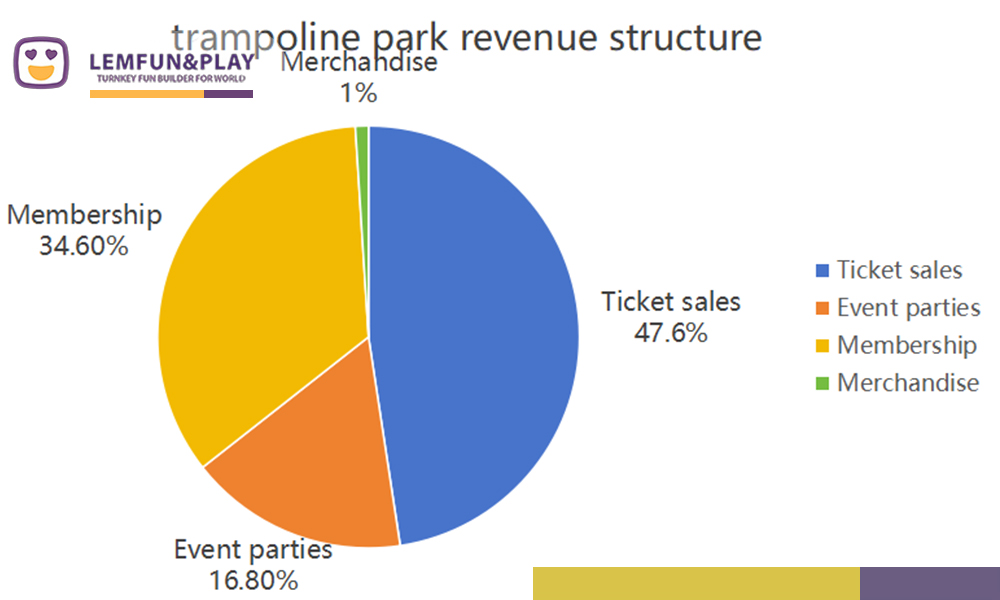
If your trampoline park mainly makes money by selling tickets, change it from now on.
In today’s hyper-competitive market, a trampoline park that only sells tickets has no long- term future, because it's unhealthy, risky, a really fragile business model.
The Case Study in Portugal
We have finished a project in Portugal recently. The client wanted wall-to-wall trampolines, butI stopped him:"You are leaving money on the table."
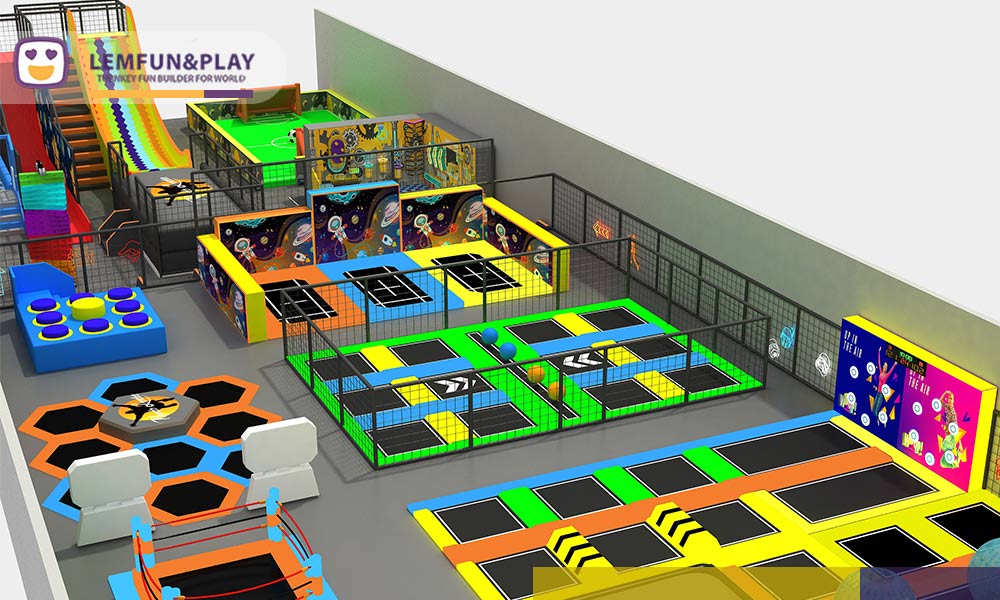
We soon remake the layout. Out of 1,400 square meters, we dedicated 900 sqm to the trampoline jumping area.AND the remaining 500 sqm has became the "cash cow" now: we designed a catering rest area, an arcade game zone, and specialized birthday party rooms. The revenue structure finally changed in the newest version of business plan. The party rooms and arcade machines cover the fixed operational costs. The jump tickets? That is pure net profit.
The lesson you can get from this case is: you'd better to calculate your "Secondary Spend Per Head." If you aren't planning for birthday parties, corporate team building, and F&B (Food and Beverage) from Day 1, your profit margins will be thin.
Suggetions for your plan:
You must calculate your "Secondary Spend Per Head." If you aren't planning for birthday parties, corporate team building, and F&B (Food and Beverage) from Day 1, your profit margins will be thin.
We always warn clients directly: you can't put the shiny toy what you saw on Instagram or face book into the trampoline park. Because the only thing I care about is your ROI (Return on Investment), instead of your ego.
The Case Study in France
A client in France inquired me with a massive budget. He wanted to add a huge VR (Virtual Reality) gaming zone in his venue, because it looked "high tech."
I immeadiately shows my concern through pointing out some factors. VR equipment is expensive. It breaks down often (high maintenance). And what's worse, the throughput is terrible for allowing only one or two kids play at a time. It actually waste space that generates zero revenue while players are under preparation before playing.I almost forced him to kill the VR idea. Instead, we focused on the vertical space—the air above the ground.
Addtionally,We installed a "Devil Slide" with small footprint and high thrill, then built a large zip line running directly above the Ninja Warrior course.
The result is very satisfactory. We strengthened the play capacity without increasing the floor area,and the client’s "Revenue Per Square Meter" smoothly rocketed. For what is the kind of efficiency you need to show in your plan.
Datas do not always shows the truth, because you can type any number into an Excel sheet for creating any cost. But new investors often calculate rent and equipment costs but miss the "Invisible Costs" of compliance. This ignorance always brings troubles in their implementation.
The Case Study in Swsis
Lemfun consluted a client in with an old dance classroom. It had a perfect location and ceilings. Obiviously, the plan we made looked wonderful after receiving more details ,and we were going to produce the equipment.
Unfortunately, the local labor board paused it. Due to the expected number of employees, the local law required a specific zone for staff restrooms which separate from customers.
Surely,the first design didn’t put this washroom, resulted in giving up the first design and making a new version in the next few week. Finally, we had to take the play area to build bathrooms.
Today, when I write a trampoline park business plan for customers, I dig deeper and deeper. Lemfun don't just ask about the building, we
also ask about fire codes, labor laws, and HVAC requirements.
What you can learn from this case:
Add a line item for "Compliance Buffer." If you think fire safety retrofitting costs $10,000, put down $20,000.
4. Sustainable Advantage outweigh Blind Differentiation"My competitor has a foam pit, so I need a bigger foam pit."This kind of thought is always a beginning of a vicious competition
Differentiation isn't only buying innovative equipment, but also useing strategies in operations.
The Austria Case Study
Once,a client in Austria called me in a hurry. He said, "Bob,there are two competitors within 3 kilometers nearby my trampoline park. They look just like mine. People will soonly get bored. Should I buy crazy new equipment?"
I paused him: "No. Never scrap your foundation, we have plenty of methods of changing the situation."
Dodgeball and Foam Pits are classics for a reason—they all work successfully. Instead of spending a fortune on these new games to replace these original games, we did two things:
Micro-Innovation: We integrated interactive projection games into the existing trampolines and basketball hoops. It costs a fraction of new heavy equipment but completely changes the visual experience.
Operational Pivot: We rewrote his event calendar to focus on tournaments and leagues.
The Result:
He didn't just have a park; he had a "League." His park became the community hub.
When you look for a trampoline park for sale, or when you build one, ask yourself: Is the equipment weird, or is the experience sticky?
5. Safety is Your Only True AssetYou can have the best location and the best marketing, but one bad accident will shut you down.
Wealthy investors often think they can outsource risk. You can’t.
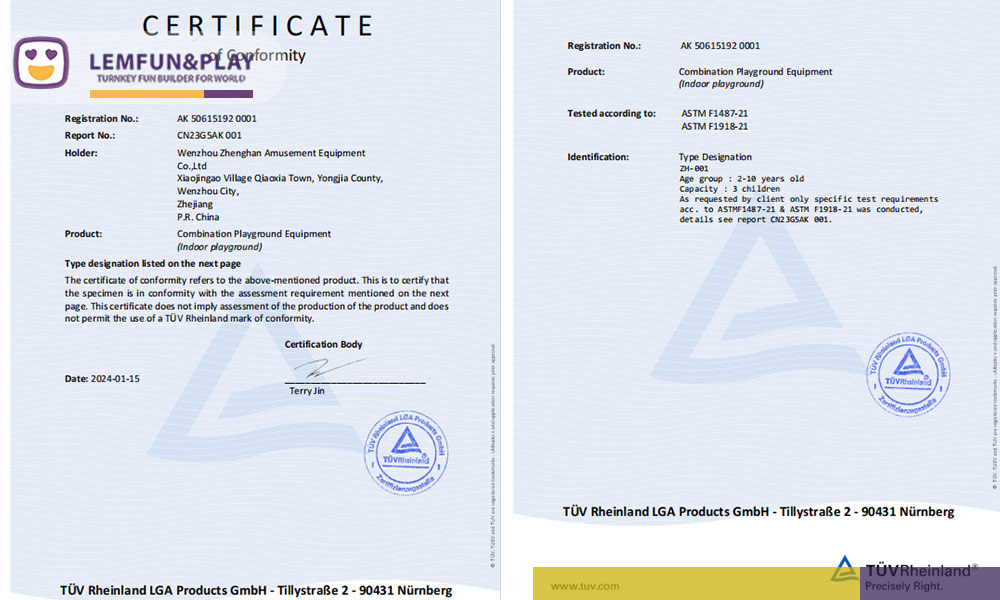
In your business plan, the "Risk Management" section needs to be the most detailed. At Lemfun, we adhere to strict ASTM and EN standards. But hardware is only half the battle.
I tell my clients: "Safety is an operating cost, not a one-time purchase."
Your plan must budget for:
Daily equipment inspection logs.
Monthly staff safety training costs.
Liability insurance premiums (which go down if you can prove you follow high standards).
You are busy. You don't want to manage construction crews.
This is why you hire a Turnkey Solution Provider. But you need to hold us accountable.
When I present a plan to a client, I include a "Landing Agreement" or a "Node Acceptance Standard."
This is a Gantt chart that tracks everything:
Design Finalization.
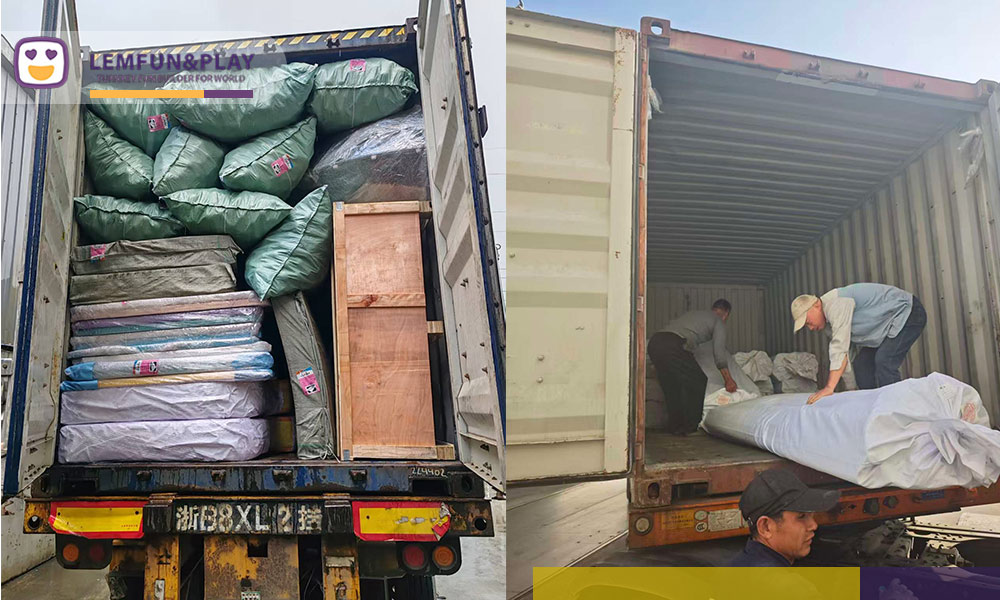
Manufacturing (often involving our [kids indoor playground in china] production base).
Shipping & Customs.
Installation & Testing.
Staff Training & Soft Opening.
The 3-Page Rule
Investors don't read 50 pages. Your plan needs to be summarized in the first 3 pages:
Page 1: The Money (ROI, Break-even point, Net Profit Margin).
Page 2: The Timeline (When do we open?).
Page 3: The Exit (How do we scale or sell?).
Q: Do I really need a formal business plan if I have my own funding?
A: Yes, because a business plan is a simulation of failure before you spend a dime.
Experience tells me that self-funded investors are actually more likely to overspend on emotional choices (like that VR machine in France). A solid trampoline park business plan acts as a rational constraint on your wallet, forcing you to justify every square meter in terms of profit, not just "cool factor."
Q: How much does it cost to start a trampoline park?
A: Stop asking about "total cost" and start asking about "cost per play feature."
The price varies wildly. A park filled with high-tech interactive games costs more than a standard jump arena. As a turnkey provider, I don't give generic quotes. I look at your ceiling height, your local competition, and your target demographic. We can source cost-effective, high-safety components from our [kids indoor playground in china] facilities, or premium custom builds. The budget depends on the "yield" you want, not just the size.
Q: Can I just buy a franchise instead of building my own brand?
A: You can, but you are paying a 6-8% royalty for a logo that might not matter in your local town.
I often help clients build their own brand. The equipment quality is the same (often better if you choose the right trampoline park for sale packages). The success of a park depends on local operations—your birthday party host, your cleanliness, your coffee—not a national logo. Why give away 8% of your gross revenue when you can hire a consultant like Lemfun for a one-time fee to set up the same systems?
Q: How long until I get my money back (ROI)?
A: If you aren't operationally cash-positive by Month 6, we did something wrong.
Typically, a well-run park targets a full ROI in 12 to 18 months. However, this depends heavily on that "Secondary Spend" I mentioned earlier. If you ignore the café and party rooms, push that ROI back to 3 years. My job as your project manager is to aggressively optimize that timeline.
Ready to stop guessing and start building?
You have the vision and the capital. I have the 10 years of scars and success stories. Let Lemfun write the plan that turns your empty warehouse into a money-printing machine. Contact us today.


We use cookies to enhance your browsing experience, serve personalized ads or content, and analyze our traffic. By clicking "Accept All", you consent to our use of cookies.
