
Get You Updated on Playground Equipment News.
New investors always come to us with two questions:"How much is your trampoline park equipment?" and "How long is the lead time?"
If you only care about these two issues, you're already close to a very expensive failure.
One client is a classic example.
He went to another playground equipment supplier because the price was very low. On paper, he "saved" a lot. In reality, he bought himself a disaster:
The layout path was wrong – parents couldn't see their kids, kids got lost in the space.
Trampoline springs and frames broke frequently – maintenance and downtime almost every week.
The foam pit was too shallow, and the foam quality was bad – guests actually got injured.
Later he came to me and said, very honestly:
"The money I saved on cheap equipment, I'm now paying back in repairs, compensation, and bad reviews."
So in this article, I'll walk you through how to open a trampoline park step by step:From venue selection, to design period, to ROI calculation, to safety inspection and installation.
We hope you shouldn't need to read another 10 generic Google articles after reading this.
Gate 1: Not every building deserves a trampoline park
Most people ask me first:"Bob, is my area big enough?"
But my first question is usually:"How high is your ceiling?"
A Canadian client once consulted me with a venue drawing.
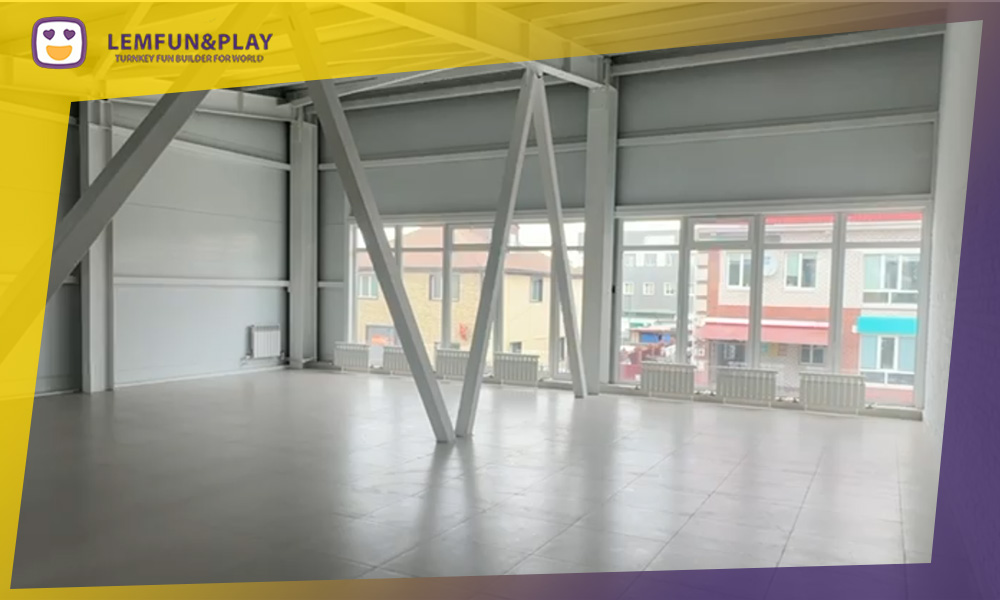
He already signed the lease and found me for a trampoline park design.That area looked okay. But I checked the height – only 3.3 meters. Obviously,He didn't realize this was a serious problem.
My first reply was very direct:"Sir, with 3.3 meters, you cannot safely build a trampoline park. As a trampoline park equipment supplier, if I say yes, I'd be hurting you, not helping."
I gave him my honest recommendation:
For a proper trampoline park, I suggest at least 5.5 m clear height.
If you want to add zip lines or devil slides, you need even more height.
With 3.3 m, forcing in trampolines is basically building a risk blackhole.
He was surprised. No one else – no other playground equipment supplier – had mentioned this to him.
Fortunately he found a better venue for his business in the end. His opening was a bit delayed, but he avoided a project that was doomed from day one.
As you know from this example:
The first step of how to open a trampoline park is not choosing equipment.It's rejecting bad venues.If you lie to yourself at this step, every dollar after that goes straight into a hole.
Gate 2: The industry may feel "no innovation", but your park can still be very vibrant Customers complain to us all the time:
"Every trampoline park looks the same from activities to layout. What's there to design?"
From a pure equipment catalog view, their complaints are not completely wrong.But from a venue concept and profit model angle, that thinking is very dangerous.
I had a client in the US with a 1,500 sqm space.
In our first call, he didn't even say hello. He started in an urgent tone:
"Bob, there are so many trampoline parks around me. They all have same attractions and all compete on price.I don't want another boring park. I want something fresh, and I want younger kids to enjoy it too."
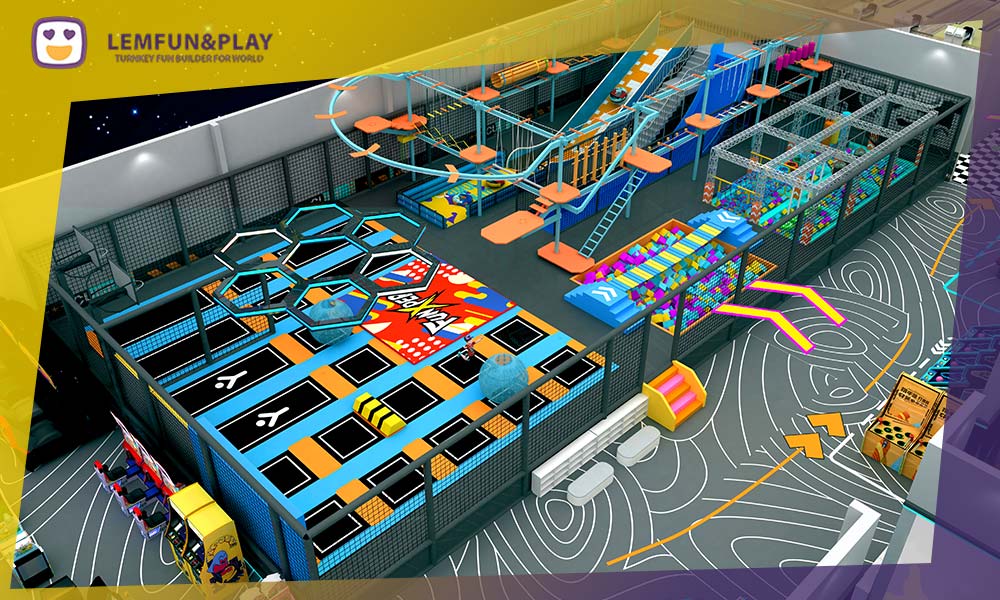
My team and I spent a lot of time on this project.What we delivered was not "just a trampoline park".
It was a trampoline-centered indoor multi-activity park.
Here's what we actually did:
First,trampoline is the core, not the cage
Near the main trampoline area, we added aerial zip line,interactive wall games and ninja course
In his local market, none of his competitors put these games into their parks.
So even though everyone was buying "trampoline park equipment", his product combination was clearly different.
Second, start from age groups, not from "cool catalog pages"
This client cared a lot about younger kids.
So we used the vertical space and added an indoor playground structure on top and beside certain zones made Kids from 3–9 years old their own playground zone.Besides,parents had visual control from seating areas.The "empty air" above the ground was turned into revenue-generating space.
Third, design for revenue, not for pretty renders
Every square meter, we asked the same question:"What here will actually make money?"
Trampolines and active play on the ground plane,zip-line crossing overhead and indoor playground structure stacked in vertical layers.
The same footprint suddenly feels like 2 or even 2.5 floors of usable space.
This is what I mean when I say:In a category where the basic equipment is similar, you win with positioning, age targeting, project mix, and vertical space use – not by adding two extra trampoline mats.
And this is the real, high-value part of how to open a trampoline park that most catalog-style articles never touch.
Gate 3: ROI is NOT just your equipment quote
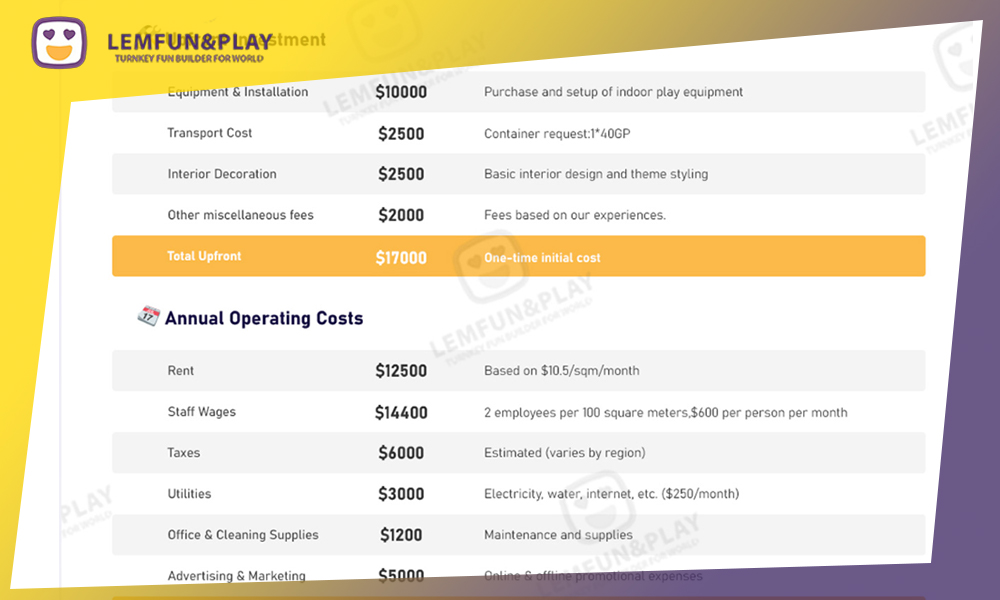
One of the most common emails I get is:"Bob, please send me a trampoline park equipment price list."Of course I can send you a quote. But if you use only that quote to decide on a 6- or 7-figure investment, you're over-simplifying your entire business.
In real projects, there are three major cost blocks that investors constantly underestimate or totally ignore:
Marketing
Many investors think a few social posts and one opening video are equal to"promotion".
In reality, to bring real traffic in, you'll need ongoing spending on:
Local social media ads
Search ads
Cooperation with parent groups, schools, influencers
Seasonal campaigns
These are real, recurring costs.
Labor
The same size park in different countries/cities will have dramatically different labor costs:
Minimum wage
How many staff you need for safety and supervision
Whether you need extra security
Cleaning staff for high footfall days
If you don't build this into your plan, your ROI will only look good in Excel.
Cleaning & Maintenance
Trampolines are not "install and forget".
Foam pits are labor-intensive to clean.
Padding, netting, safety mats all require regular inspection and replacement.
Cheap equipment breaks more often, which means downtime repair costs bad customer experience.
At Lemfun, when we talk about ROI with clients, we don't just say:
"Your trampoline park equipment costs X."
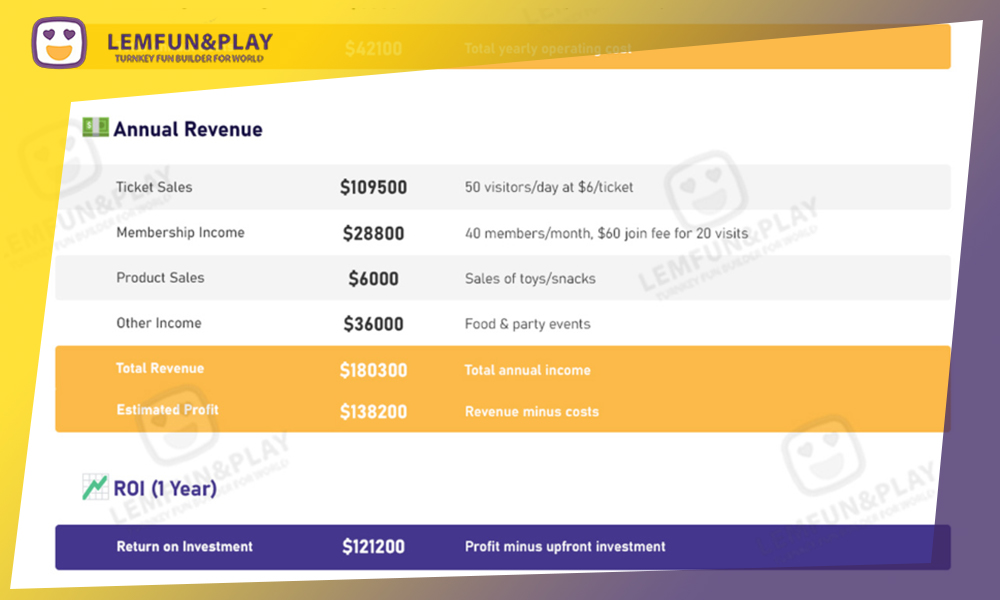
We typically ask first:
What city/country are you in?
What are the average local ticket prices?
How many competitors around you?
What's your rent, roughly?
What's the typical wage for floor staff?
Then we run a simple, straightforward payback analysis.
Because I know very clearly:
You're not buying steel and springs. You're buying a profit machine that should run for many years.
That mindset is at the heart of how to open a trampoline park that actually survives, not just opens.
Gate 4: Safety standards are the bottom line, not the goal
I've seen too many trampoline parks go out of business because of injury incidents.
So inside Lemfun, we have a very simple rule:
Design can compromise. Project list can shrink.
Safety cannot.
One client gave me a very "cool" idea:
He wanted a zip line running around the entire trampoline area, above everyone's heads.
Sounds exciting, right?
The venue height, however, was only 5.5 m.
And he also wanted high-performance trampolines – the kind where jumpers can reach very high vertical height.
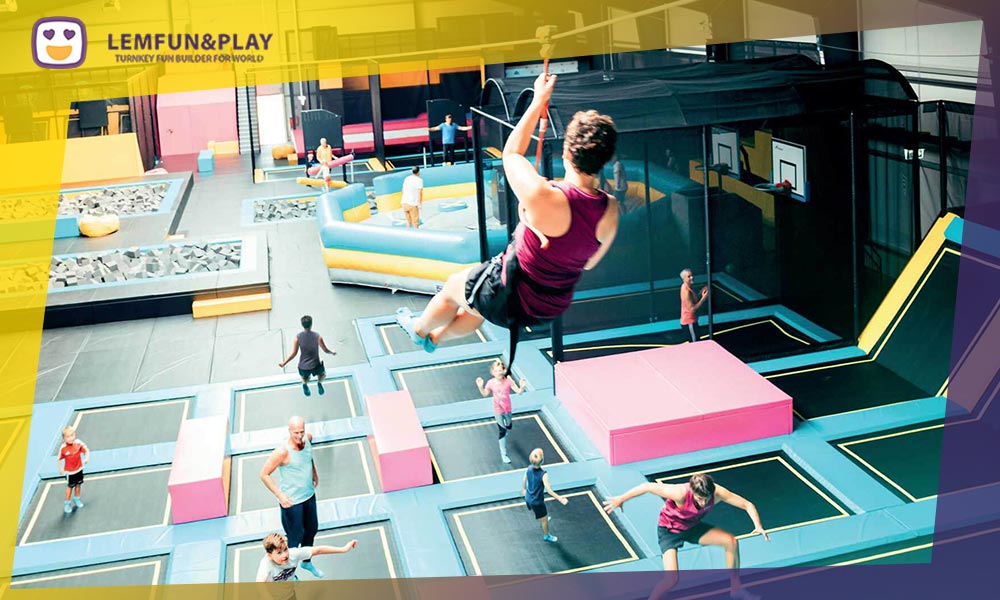
My first reaction was:
"This is dangerous in your venue. We cannot do this."
Here's why:
High-performance trampolines let users jump much higher than regular trampolines.
If you run a zip line path right above that zone, even with calculations, the safety margin is very thin.
5.5 m is not a lot of headroom to place trampoline, structure, fall space, and an overhead activity safely.
The client insisted at first:
"But I want something more thrilling than my competitors. No one else has this."
I still refused:
"If you want a thrilling feature, I can suggest other activities.
But this zip line path, in this venue, is not safe. I won't do it for you."
He cooled down and finally dropped the idea.
I know some playground equipment suppliers would happily say yes and just draw a nice 3D model.
But for me, how to open a trampoline park starts with how to keep it safe.
If we can't agree on that, there's no point talking about anything else.
Gate 5: Overseas projects – what if engineers can't fly in?
Anyone doing export projects knows:
The world has been far from stable in recent years.
The traditional model for a playground equipment supplier like us used to be:
Produce in China
Ship to client country
Send installation engineers to do full on-site installation & training
Now, things are not always that simple.
We had a client in Mexico.
He bought a full trampoline park equipment package from us.
Design, production, shipping – all smooth.
Then, last step: our engineer's visa got rejected.
We had two options:
Keep fighting with immigration (delaying opening by months), or
Change the installation strategy quickly.
We chose the second. Here's what we did:
Recorded detailed installation videos
Our engineer filmed each key part: structure assembly, trampoline frames, padding, safety zones, etc.
Wrote a clear, visual installation manual
Not some literal translated junk.
Step-by-step instructions, diagrams that a local team could understand even if they don't speak Chinese.
Refunded the on-site installation fee & recommended a local team
We had worked with a Mexican installation team before.
We introduced them to our client, and then guided them remotely via video calls.
Result:
The park still opened on schedule.
After that, we turned this "crisis handling" into a standard operating procedure:
For countries with known visa risk, we prepare a full remote install plan in advance.
We keep building a network of reliable local installation partners.
We design packaging and manuals with remote install in mind.
That's why I say:
We're not "just" a playground equipment supplier.
We act more like a project caretaker from start to finish.
Gate 6: Tech and interactivity are bonuses, not your foundation
Many investors love "technology":
Interactive projection, VR, AR…
If it looks futuristic, they want it.
But here's the reality in many parks overseas:
Software versions are not compatible with local systems.
Voltage or power specs don't match.
No local tech support team available.
Result:
The most expensive "high-tech" attractions become dead displays in 3 months.
So at Lemfun, I use three hard rules for tech-based attractions:
Operation & maintenance must be simple
Your staff are not IT engineers.
After basic training, they should be able to reset, calibrate, and troubleshoot common issues.
Language localization is non-negotiable
If your country is Spanish-speaking, but all system menus are only in Chinese or English,
daily operation will be a nightmare.
Strange as it sounds, I see this mistake all the time.
Hardware software must be stable
I would rather not sell a "flashy" VR attraction,
than see your staff constantly reboot it in front of annoyed kids.
So if you ask me:
"How to open a trampoline park with technology that actually works?"
My answer is:
For your first park, prioritize stable revenue and low failure rates.
Keep tech attractions to a reasonable small proportion.
Once your brand and cash flow are stable, then gradually add more complex tech projects.
Technology should boost your experience, not become a daily bomb in your operations.
Gate 7: A beautiful park nothing but a profitable park is everything
Many new clients ask me:"Can you make the design look very high-end and cool?"
Of course I can.But I always ask back:
"Are you building a park for social media photos, or for monthly profit?"
At Lemfun, when we design a layout, we start with such practical questions:
Which zones are direct ticket revenue and high-margin add-ons?
Which zones increase dwell time and upsell opportunities?
Here are two examples:
1.Parents' café / lounge
Kids may play for 1–2 hours.But Parents are actually free or even bored.
If you don't give them comfortable seats, drinks,snacks,charging points
and clear view of their kids,they will stand at the door or leave to another shop.
So a proper café corner turns idle parents into paying customers and extends their stay, which often means the kids stay longer and spend more too.
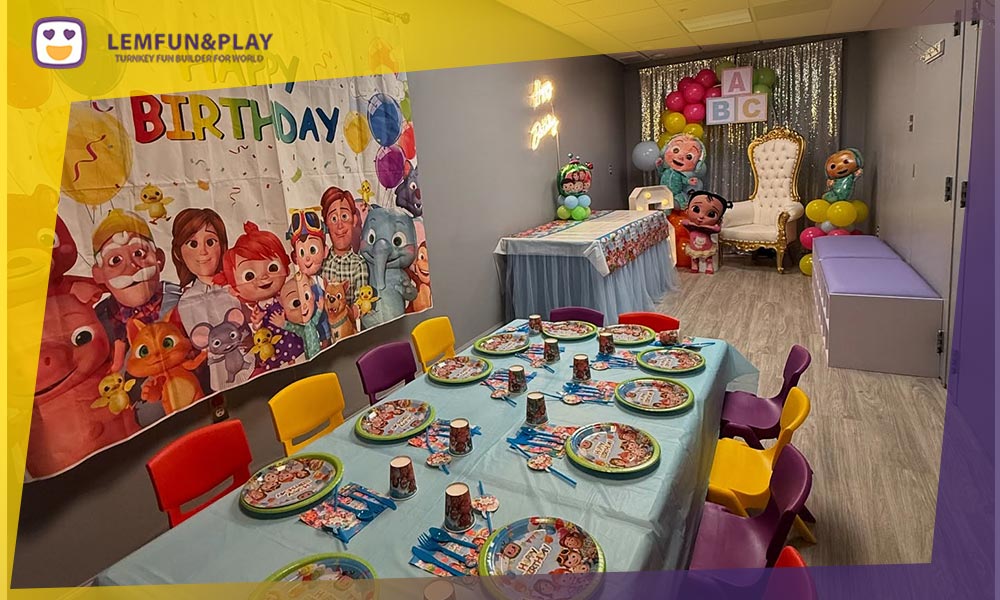
2.Birthday party zone
This is one of the most underestimated profit engines.
One birthday party booking can be equal to many regular day passes in revenue.For a profitable trampoline parks, party and group bookings are a huge part of the monthly turnover.
Therefore, we should prepare for your park: a dedicated party area, party packages (including catering, cake, host, decorations), and a reservation system for weekends and holidays.
Some customers asked:"Why is your trampoline park equipment about more expensive than some other suppliers?"
My answer is simple:"Because our equipment can last much longer than many of the cheap sets."
If you plan to open for just 2–3 years and then give it up, maybe cheap equipment feels okay.
But if your time horizon is 5–10 years, you have to calculate annual depreciation,repair frequency,downtime loss and safety-related risk and so on
That's what I mean when I say:
The true cost of how to open a trampoline park is not the price on the invoice, but the entire lifecycle of your park.
If you already have a venue, or you're choosing one now, and you don't just want "a price list", here's what you can do:
Send me with these information:
Your venue dimensions and clear height
Location (city, country)
Basic target customers (age range, price level)
I'll look at it the same way I do for my real projects and tell you:
Whether this venue is even worth turning into a trampoline park
What scale and project mix it can realistically support
Roughly how your ROI might look if you do it right
That, in my eyes, is the only honest starting point for how to open a trampoline park that lasts.


We use cookies to enhance your browsing experience, serve personalized ads or content, and analyze our traffic. By clicking "Accept All", you consent to our use of cookies.
