
Get You Updated on Playground Equipment News.
I have spent ten years on the factory floor and in the boardrooms of international indoor playground equipment manufacturers. I have seen million-dollar projects in London, New York, and Sydney padlocked by the fire marshal before they sold a single ticket. Why? Because the owners fell for a "pretty" 3D render instead of a compliant engineering plan.
If you are looking for a "cheap" quote to save 10% on your startup costs, close this page. This guide is for the serious investor. The one who wants to pass inspections on the first try, keep insurance premiums at rock bottom, and avoid a multi-million dollar lawsuit when a 250-lb adult hits a high-performance mat.
In this business, "cheap" is the most expensive word in the dictionary. Let’s look at the reality of building a park that actually opens and stays profitable.
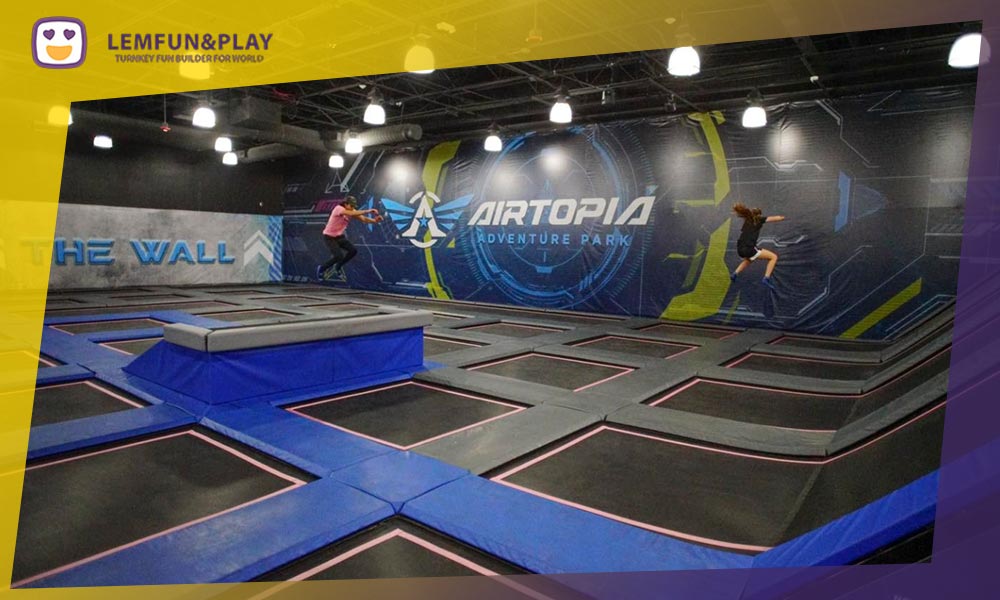
I get calls every week from investors who have already signed a lease on a warehouse with 4.5-meter (15-foot) ceilings. They ask, "Can we make it work?"
My answer: No. Do not sign that lease.
In the industry of trampoline park equipment for sale, "Clear Height" is the distance from the floor to the lowest hanging obstruction—usually a sprinkler pipe, a HVAC duct, or a steel beam.
The 5.2-Meter (17-foot) Minimum
This is your absolute floor. If you have 5.2 meters, you are already making massive compromises. At this height:
You cannot install high-performance trampolines.
Your Ninja Warrior course will be restricted to "kids-only" heights.
Adult jumpers will feel claustrophobic, and the risk of "ceiling strikes" (head injuries from hitting the ceiling) skyrockets.
The 6-to-8 Meter Gold Standard
If you want to dominate your local market and host corporate events or high-level athletic training, you need 6.5 to 7.5 meters of clear height. This allows for:
High-Performance Zones: You need at least 3 meters of clearance above the trampoline bed for professional-grade mats.
Double-Level Ninja Courses: If you want that "wow" factor that brings in repeat customers, you need height for verticality.
The Risk of Ignoring This: I’ve seen clients buy equipment, ship it across the ocean, and then realize they can’t install it because they didn't measure the lowest sprinkler pipe. They end up paying me $20,000 to "shorten" the frames, ruining the bounce quality and their reputation. Take a laser measure to the site before you sign the lease. Measure the lowest point.
2. Fire Sprinklers: The 18-Inch "Death Zone" and the Under-Floor Nightmare
Fire inspectors don't care about your ROI. They care about their code book. I have seen more parks delayed by "Sprinkler Conflict" than any other issue.
The 18-Inch Rule
In almost every jurisdiction in North America and Europe, you must maintain at least 18 inches (45cm) of clear space between the top of your equipment and the sprinkler heads. If your equipment is too tall, you have two options:
Lower the equipment (killing the bounce quality).
Move the sprinklers (costing $15,000 - $50,000 depending on the facility size).
The Under-Trampoline Sprinkler Requirement
This is the "Hidden Cost" that kills startups. Because a trampoline platform is raised (usually 1 meter off the ground), it creates a "void" where dust and trash can accumulate. In many cities, the Fire Marshal will classify this as a "hidden combustible space."
The Result: They will force you to install a complete secondary sprinkler system underneath the trampolines.
The Pro Move: As a veteran manufacturer, we design our frames to be "access-friendly." We provide fire-resistant mesh skirts that allow for airflow and visibility, which sometimes helps us negotiate these requirements with inspectors. But if your factory doesn't know these rules, you'll be hit with a $30k plumbing bill on opening week.
The market is flooded with "fake" certificates. Every factory will tell you they are "ASTM compliant." Most are lying. They have a 5-year-old PDF they photoshopped or "borrowed" from a reputable competitor.
The Real Standards You Need:
North America: ASTM F2970 (Design, Manufacture, Installation, and Operation of Trampoline Courts).
Europe: EN 13219 and EN 1176.
Australia: AS 3533.4.2.
How to Verify a Manufacturer:
Check the Name: If the company name on the certificate doesn't match the name on the Proforma Invoice, walk away.
Check the Date: Safety standards are updated. An ASTM report from 2018 is useless in 2024.
The Insurance Test: Send the manufacturer’s certificates to your insurance broker before you buy. If the broker says "I can't underwrite this," the certificate is trash.
My Experience: I’ve seen owners lose their entire investment because a kid broke an arm, and the insurance company discovered the equipment wasn't actually ASTM-certified. The insurance company denied the claim, and the owner was personally sued into bankruptcy. Don't be that guy.
4. The Fire-Retardant Lie: The Lighter Test and the "PVC Fraud"
Cheap factories save money on the things you can't see: the foam and the PVC skin. This is where most "bargain" trampoline park equipment for sale fails.
The PVC Trap
A quality PVC skin (1000D, 0.55mm) is expensive because of the flame-retardant chemicals infused in the material. Cheap factories use "Advertising Grade" PVC. It looks the same in a photo, but it burns like gasoline.
The Foam Deception
They will send you a "Golden Sample" in the mail that is perfectly fire-retardant. Then, they ship you a container full of standard upholstery foam to save 15% on production costs.
The Inspection Reality
Imagine it’s opening day. The fire marshal walks in. He doesn't look at your paperwork. He pulls out a lighter and holds it to the padding on your main walkway. If it catches fire and drips black, acrid smoke, he will padlocked your door right then. No second chances. No "fix-it" period.
What We Do: We use 1000D, 0.55mm PVC that is certified to the highest fire-resistance ratings. When the marshal holds the lighter to our padding, it self-extinguishes within 2 seconds. That is the "Veteran Confidence" you are paying for.
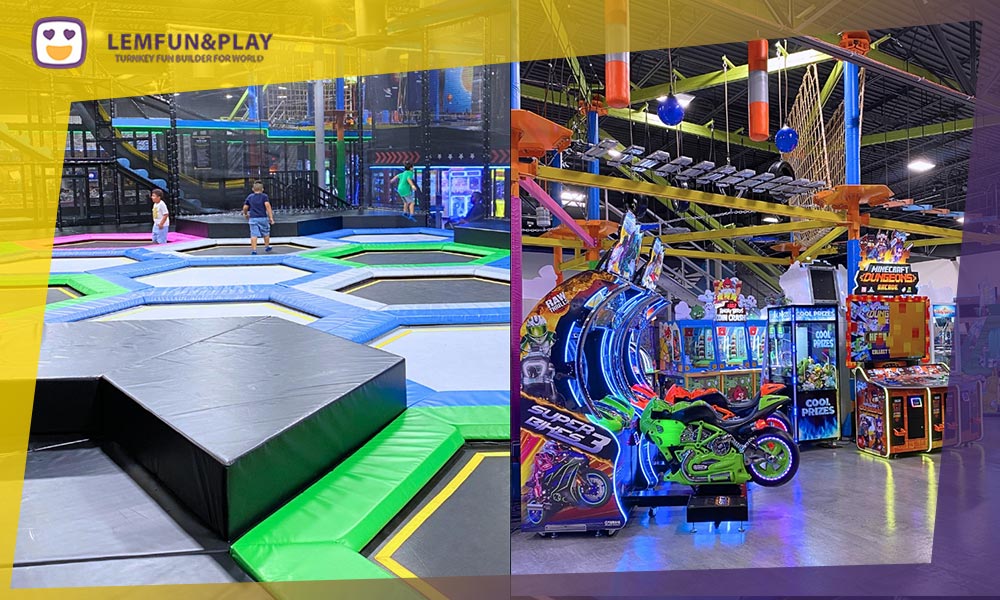
In the trampoline park world, your biggest ongoing cost isn't electricity—it's Liability Insurance.
Risk Engineering
Insurance companies treat trampoline parks like nuclear plants—high risk. When they look at your floor plan, they are looking for "Risk Points":
Thin Padding: If your padding is under 3 inches (7.5cm) thick, your premium will be 20% higher.
Narrow Walkways: If your paths are cramped, you have a higher risk of "Collision Injuries."
Blind Spots: If your staff (court monitors) can’t see every square inch of the jump area from a single vantage point, you are a "high-risk" operator.
How We Lower Your Premiums: We design for the "worst-case scenario." We use thicker soft-padding, finer mesh netting that fingers can't get caught in, and high-tension springs that don't snap under a 120kg load. When you show your insurer a layout from a top-tier indoor playground equipment manufacturer with proven safety stats, your premium drops. That's money back in your pocket every single month.
6. Structural Integrity: The Physics of "Dynamic Load"
A trampoline park is not furniture. It is a machine that undergoes thousands of "dynamic load" cycles every day.
Steel Gauge and Fatigue
Low-end factories use thin-walled steel (2mm or less) to save on shipping weight. Within six months, the frames will start to "bow" or bend. The weld points will crack.
The Industry Standard: We use 80mm x 80mm galvanized steel pipes with a minimum thickness of 3mm.
The Corrosion Factor: If your factory doesn't use proper galvanization (inside and out), the sweat from the jumpers will corrode the frames from the inside out in less than a year.
The Concrete Slab
Your warehouse floor must be able to handle the weight. We provide a "Floor Load Map" that tells your architect exactly where the pressure points are. If you don't have this, you are guessing—and guessing with a concrete floor is a recipe for a structural disaster.
7. ADA Compliance: The Invisible Space Killer
If you are building in the United States, Australia, or the UK, you cannot ignore accessibility.
The Ramp Problem
Most trampoline platforms are 60cm to 100cm off the ground. To make that wheelchair accessible with a legal slope (usually 1:12), you need a ramp that is 12 meters long.
The Mistake: Owners forget this in the design phase. They fill their floor with equipment. Then the city inspector comes and says, "Where is your ADA ramp?"
The Fix: You are forced to tear out $30,000 worth of trampolines to fit a ramp you didn't plan for.
Our Solution: We integrate ADA ramps or lifts into the design from Day 1. We balance the "Playable Area" vs. "Legal Compliance" so you don't lose a single square inch of revenue-generating space.
You are putting 200 teenagers in a room and making them do high-intensity cardio. If your ventilation is wrong, your park will smell like a locker room and feel like a sauna. This kills your "Parent Experience." If parents are uncomfortable, they won't bring their kids back.
The ACH (Air Changes per Hour) Requirement
Building departments will check your HVAC specs against the occupancy limit.
The Pro Move: We coordinate with your HVAC engineers early. We provide the "heat load" data for the equipment areas so they can size the units correctly.
The Cost-Saving Tip: Proper airflow prevents the buildup of humidity, which protects your equipment from rust and prevents the foam from absorbing "stink."
9. The PE Stamp: Your Bridge to Legal Approval
In the US, Canada, and Australia, the city won't take my word for it. They want a PE (Professional Engineer) Stamp.
This is a local engineer signing off on our structural calculations. They are putting their professional license on the line.
The Data Package: We provide the "Calculations Package"—the steel load-bearing specs, the weld points, and the floor-weight distribution.
The Barrier: Without this data from the factory, your local engineer will charge you $20,000 just to "reverse engineer" the drawings. We give it to you as part of our service. This is what separates a source factory from a "trading company."
10. The Lifecycle Cost (LCC): Why "Cheap" is a Trap
Let’s talk about the Total Cost of Ownership.
Factory A (The Bargain): $150,000. Equipment lasts 18 months. High maintenance. Fails initial fire inspection (costs $20k to fix).
Factory B (The Veteran): $185,000. Equipment lasts 6-8 years. Low maintenance. Passes inspection in 1 day.
In two years, Factory A has cost you $250,000 in repairs, downtime, and legal fees. Factory B has already paid for itself. As a manufacturer, I don't sell you steel; I sell you a business that stays open.
Q: Can I use a cheaper factory to save on the initial investment?
A: No. The "savings" will vanish the moment you fail your first fire or structural inspection.
My Experience: I have seen owners save $40k on equipment only to spend $80k on emergency modifications and an extra 5 months of rent because they couldn't get their operating permit. Cheap equipment is a high-interest loan you pay back in stress, lost revenue, and late-night repairs.
Q: Is the 5.2m height really a "hard" limit?
A: Only if you want to be profitable. If you go lower, you exclude adults and high-performance athletes—your two highest-paying demographics.
My Experience: Parks with 4.5m ceilings are usually "toddler-only" zones. They struggle because they can't host teen parties or corporate team-building events. You are cutting your market in half to save a few bucks on rent. It’s a bad trade.
Q: Why do I need a PE Stamp if the factory already tested the equipment?
A: Because the City Council doesn't trust the factory; they trust their local engineers.
My Experience: We make the PE’s job easy. By providing a full engineering data pack (structural analysis, force distribution), we turn a 4-week engineering review into a 3-day "check and sign" process. Speed to market is your biggest competitive advantage.
Q: How often do I need to replace the springs and mats?
A: Only if you buy low-quality steel.
My Experience: Our high-tension, piano-wire springs are rated for 1 million cycles. Cheap springs will start to "sag" in 4 months, making the park look old and dangerous. Spend the money on quality springs now, or spend every Monday night replacing them.


We use cookies to enhance your browsing experience, serve personalized ads or content, and analyze our traffic. By clicking "Accept All", you consent to our use of cookies.
